• spindles
  • textiles
  • works
  • research
  • blog
  • about
  • publications & resources

eine Saite

  • spindles
  • textiles
  • works
  • research
  • blog
  • about
  • publications & resources

about texture

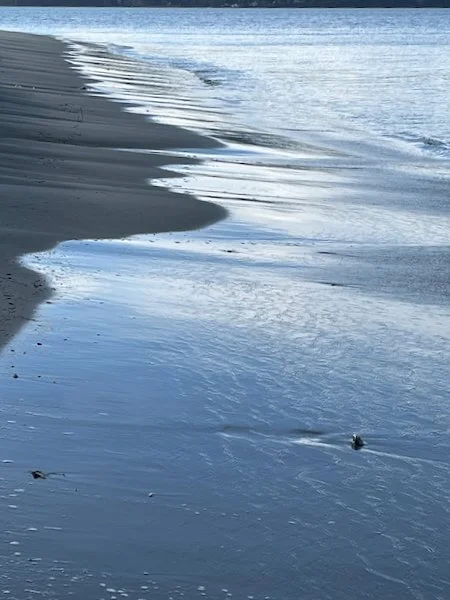
Receding wavelets’ shimmering smoothness

Walking on the winter beach a couple of months back, I was thinking of previous experiences and what I wrote about them. I went to search for these writings, by typing in the title of my website and the word ‘beach’. (This is the easiest way to find something in here, if you can remember key words - pair them with ‘einesaite’ in a search, and it will find posts that include the keyword, or that use that tag.) This time, I forgot to add “-ai” to the end of my search, which removes the automatically generated AI results (and, I can only hope, reduces the environmental strain by a drop), and so I got the following overview: ‘“Einesaite” appears to be the name of a blog/website focusing on nature, poetry and textures (forests, landscapes etc.) not a specific beach itself.’ Of course, I hadn’t realized it looked like I was searching for a beach named Eine Saite. What intrigued me though, was that this machine-guided language hunting determined that my blog is about “textures.” No mention of textiles, or weaving, which is interesting, but - textures. Yes, this is a blog about textures, more often than not.
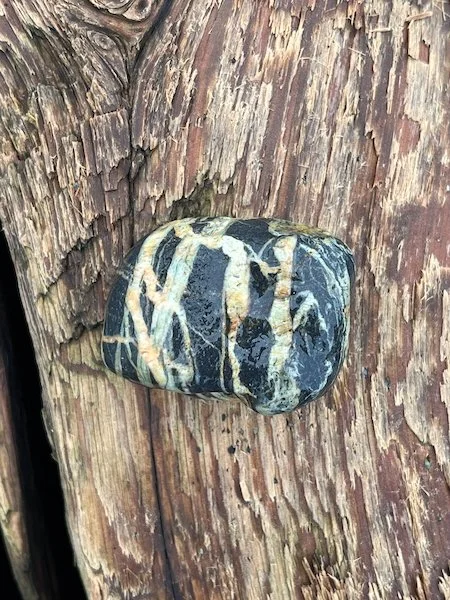
Rock surface and bark surface interacting

I wrote in November last year, “Today every detail looks sharp and eloquent, each texture speaking its richness, particular and wise.” I think about texture most of the time - it’s inherent to fiber work and collage, and garden work, also just the work of seeing, noticing, differentiating.

I think about how a lack of texture is presented as a good or desirable thing, especially in this time of digital enhancement, the increased capacity to erase anything considered faulty or blemished in a surface or image. Something Bayo Akomolafe said about industrialization in an interview on the Emerge podcast comes back to me: the land “was smoothened and flattened, and all the sacred & bumpy and groovy places were rejected and pathologized.”

This process continues, with newer products smooth, slick, frictionless - as our bodies are also supposed to be, advertisements tell us: no snags, no ripples, no bumps or wrinkles. A perfection of limbs based on Barbie doll ideals and supermodel svelteness, all of which denies the reality of growing, which makes marks. Bearing children, being chldren, interacting with a tangible world that leaves scars in undramatic ways - a stray spark from a fire, a brief moment of inattentiveness in a kitchen, a young animal’s scratching, biting exploration of their world - all of this makes marks, leaves behind a language of experience which the digital ideal would smooth away. Give you instead the countenance of an anime hero, large-eyed, pale and smooth, sword-wielding and scarless.
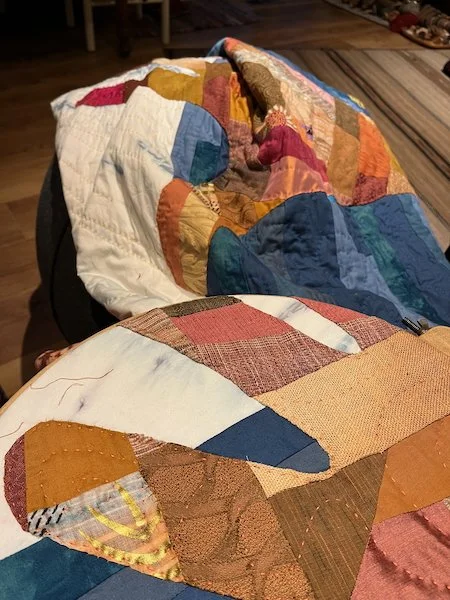
Lap view of quilting in progress… large appliqué hands reach out
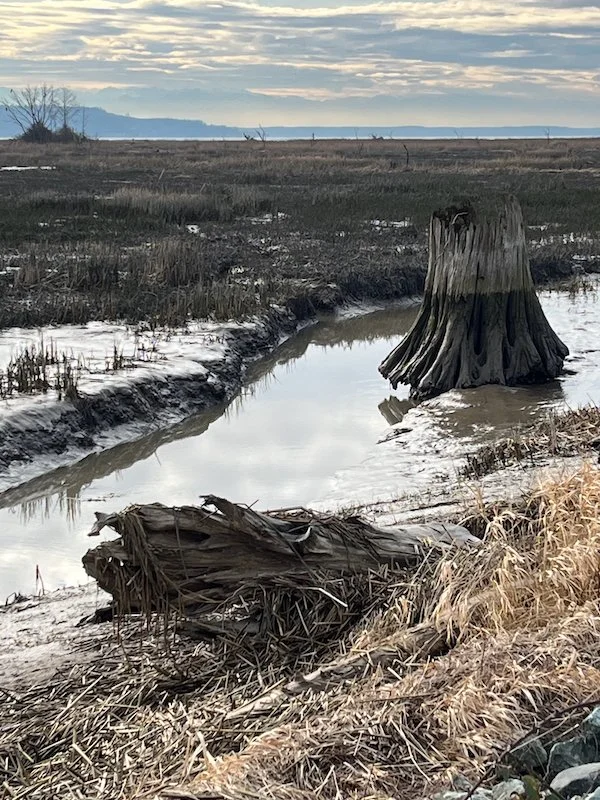
Textured winter estuary, Skagit Bay Wildlife Preserve

This comes up for me when reading or watching futuristic fiction, where people in outer space live in rounded, smooth-walled spaces and plant or animal fiber clothing is a thing of the past. I can’t help thinking it’s a textureless fantasy promoted by those who would “smoothen and flatten” all surfaces. Never mind the kitchen, the laundry, the garbage, the need to rake leaves or shovel dirt - your texture-free existence spares you all that! But how would that actually work… and is it any wonder that people disassociate or feel untethered when faced with this so-called ideal? We need grounding in those textured activities, the scratchy and crumbly and ragged-edged reality of the natural world. I’m not going to cite studies or expert analysis - you know this. You know that to get your hands dirty in soil or sand or clay, to simply hold a stone, or a cat, or a ball of yarn — it helps. Something real asserts itself, and you feel more alive, and more a part of everything (rather than apart from everything). You feel the texture of something, and you feel the texture of yourself.
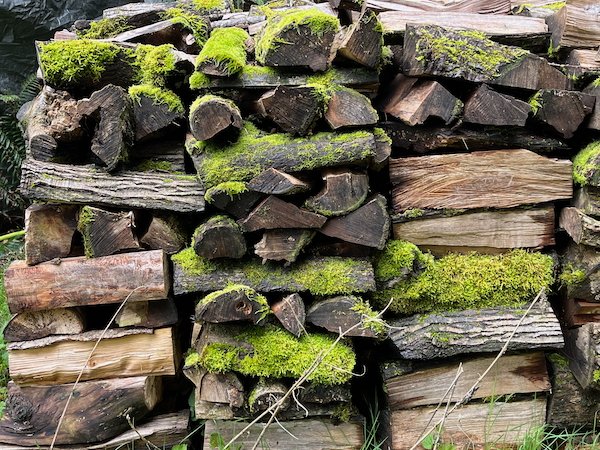
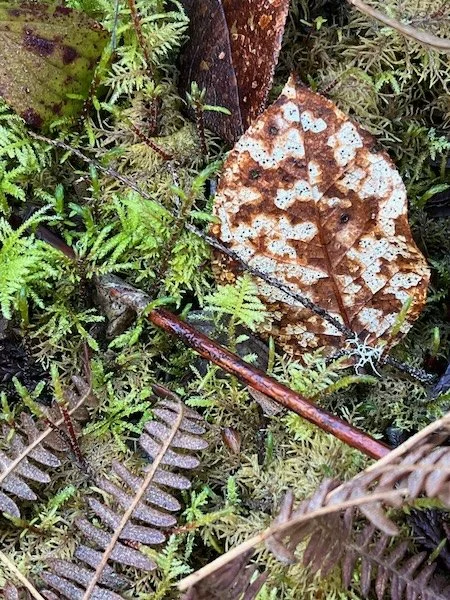
Mossy firewood stack, speaking its own language

The friction of your interaction with the world — even against the air, or in water, or walking on asphalt, that point of contact is never utterly smooth or frictionless. (I remember in Physics class, our teacher had to specify that certain things were occurring on Frictionless Pond, in order to use equations that could disregard the variables caused by friction. The point was, it doesn’t exist.) Friction is always there, it defines our participation as a body. Your texture is your language of interaction with all that surrounds you.
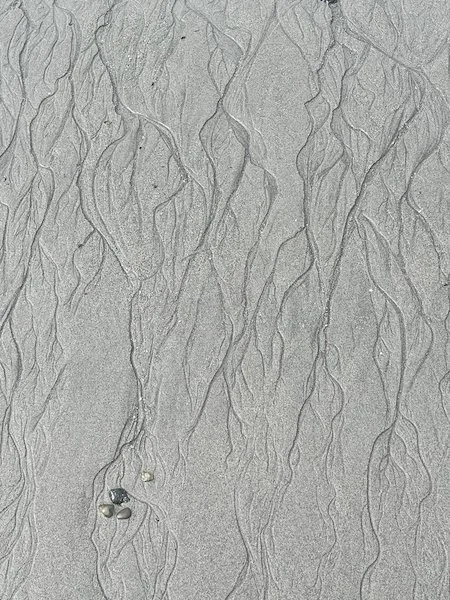
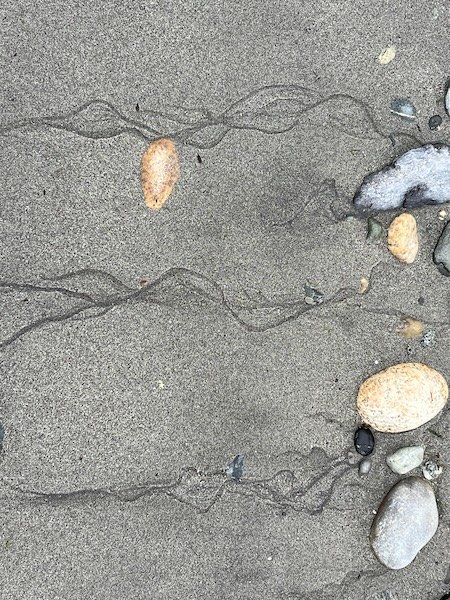
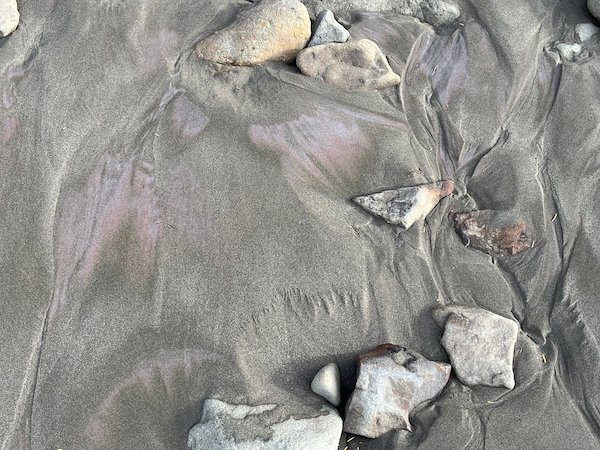
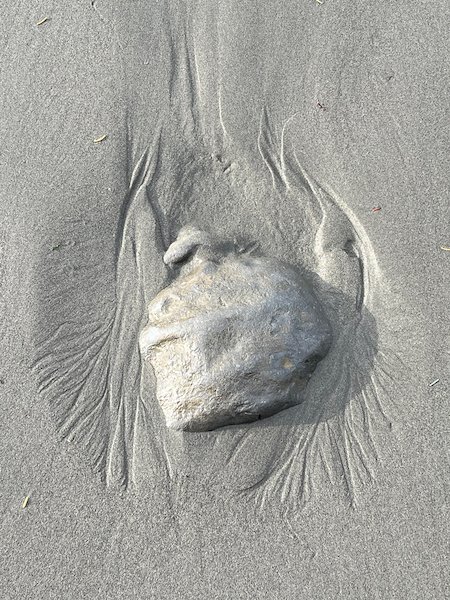
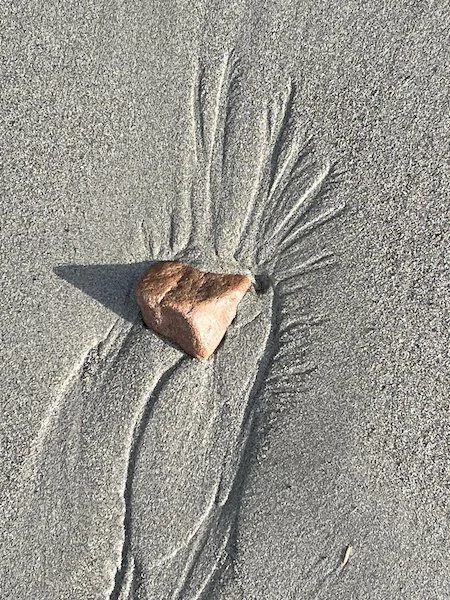
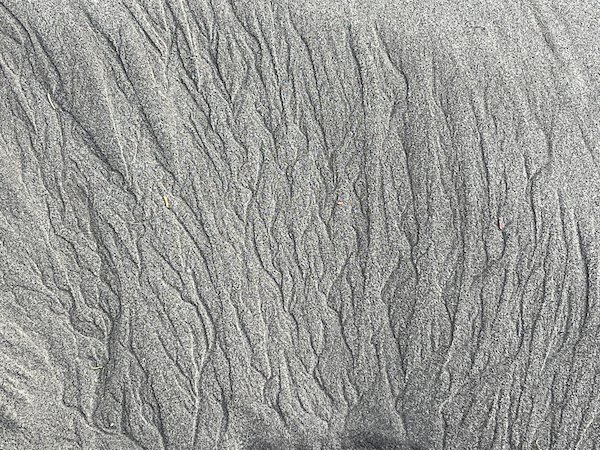
Tide trails on the sand, like tiny rivers.
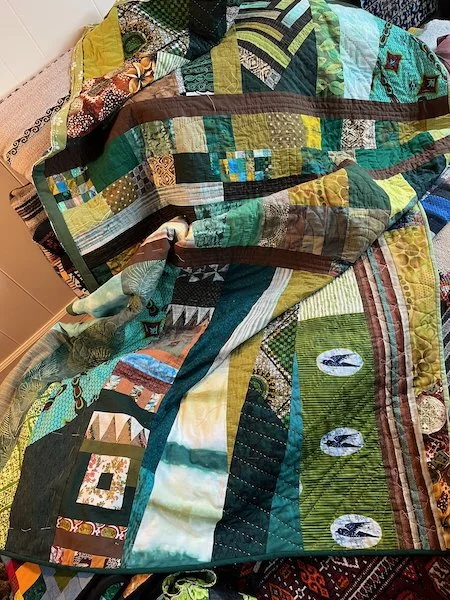
Another quilt in progress, quilted lines furrowing the surface

Your texture is what I love about you; it is who you are.
Pablo Neruda, in “Toward an Impure Poetry,” wrote:

The used surfaces of things, the wear that the hands give to things, the air, tragic at times, pathetic at others, of such things — all lend a curious attractiveness to the reality of the word that should not be underprized.

In them one sees the confused impurity of the human condition, the massing of things, the use and disuse of substances, footprints and fingerprints, the abiding presence of the human engulfing all artifacts, inside and out.

Let that be the poetry we search for: worn with the hand’s obligations, as by acids, steeped in sweat and in smoke, smelling of lilies and urine, spattered diversely by the trades that we live by, inside the law or beyond it.

tags: textiles, quilts, beach, texture, stones, wood, poetry, decolonize, nature, beauty
Tuesday 04.21.26
Posted by Tracy Hudson
 

moss energy

What I love about the picture above is that I really can’t tell you what is going on there. I still don’t know yet. But the alchemical invitation of combined elements feels activated, there is potential for an emergence of some kind, however small and searching. That’s the nature of my studio space these days. It holds and pools and mixes together images, textures, acts of mark making and folding and tying - possibly generating amulets, or maybe the assemblage itself is the amulet, a protected and protective space to hold thoughts that wish to heal and halt destruction.

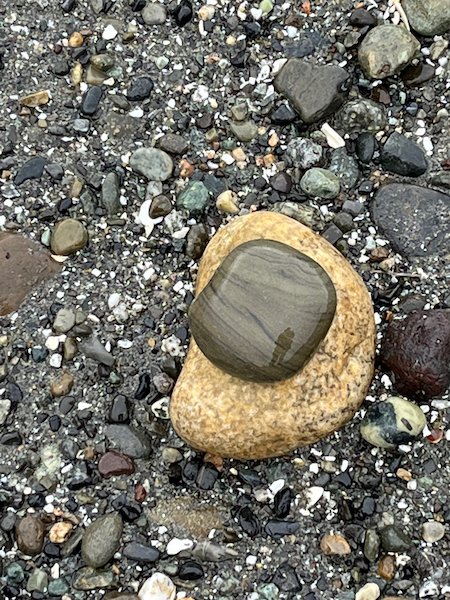
This rock also felt strongly of healing and wholeness. Such a wise and soothing design, so smooth and comfortable in the hand. I carried it along the beach, my first time back since an incident of local violence, and I left it there to mark the site with its calm assurance, another hope for healing and reparation.

I only feel capable of temporary offerings these days, momentary indications of care and tentative hope. I gain reassurance from these ancient forms that don’t need us humans, really.

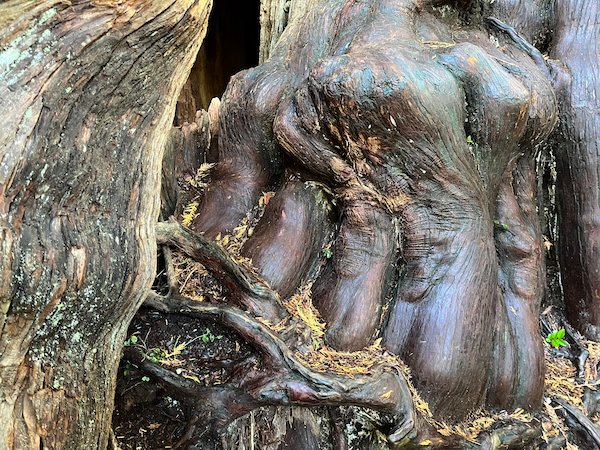
A cedar showing me the beauty of a difficult life.

In preparation for a moss walk with the land trust study group, I was thinking about two aspects of mosses’ being. First, their extreme delicacy and sensitivity: with leaves only one cell thick, mosses have no protective layer filtering the outside world. The environment permeates their cells, making them highly susceptible to toxicity and air pollution. At the same time, many mosses are drought tolerant, can essentially go dormant until conditions are suitable to flourish, and when land has been depleted through mining or deforestation, they are often the first to come in and begin to find ways to grow. As some of the oldest plants on the planet, mosses have an ability to make soil habitable for other organisms. So they are simultaneously more sensitive, and more likely to create the conditions for communal thriving. These sound like the kind of characteristics the world needs, and it’s encouraging for those of us who have the experience of being too sensitive, feeling too much and too easily, to recognize that we also may have the capacity for encouraging better conditions for everyone, for starting over with small-scale care and attentiveness.

I roll it around in my mind as I visit the mosses and watch the birds and handle fiber: slow, gentle delicacy as teaching and strength.

Cotton from Traditions in Cloth, leather-whorl spindle by Allen Berry

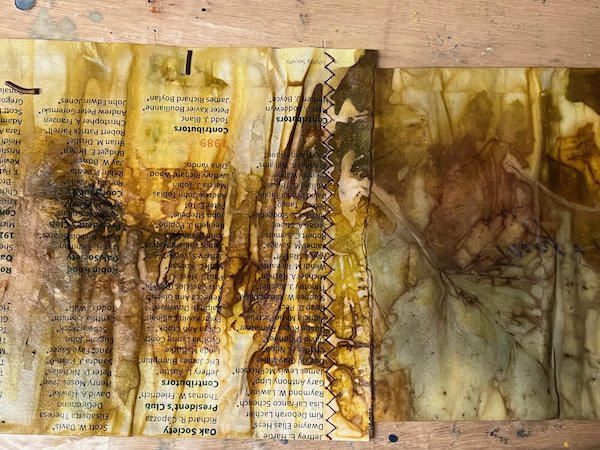
Recycled paper stitched together and dyed with onion skins.

Maybe that’s where hope resides - with those of us who are unable to tolerate bombing of children, hospitals, libraries. Maybe our very intolerance, our inability to harden against this unacceptable reality, is what will create conditions where more of us can grow together.

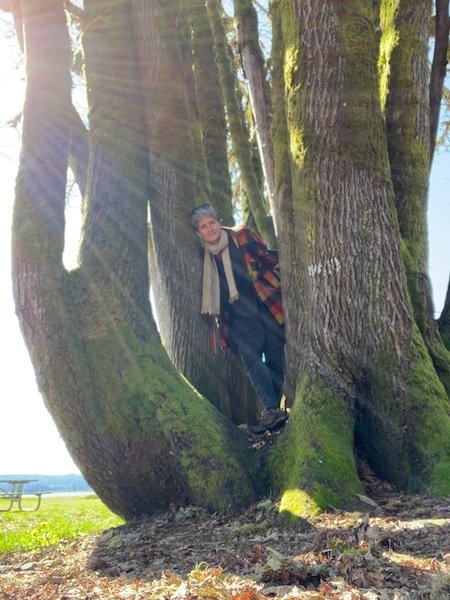
A Bigleaf Maple offering shelter & embrace.

Small, persistent offerings feel small, but also crucial, as so much is being wantonly destroyed. Like the stitches in this Palestinian embroidery, creating meaning and preserving an attentiveness to life, to identity and place.

Palestinian cross stitch, found by chance in a local consignment shop. Someone tells me it has West Bank motifs from the Bethlehem area (thank you, Dot Ranch!) Along the right side are cedar/cypress trees of life.

tags: moss, textiles, embroidery, beach, stones, nature, poetry, palestine, worksonpaper, decolonize
Wednesday 05.29.24
Posted by Tracy Hudson
Comments: 2
 

more listening

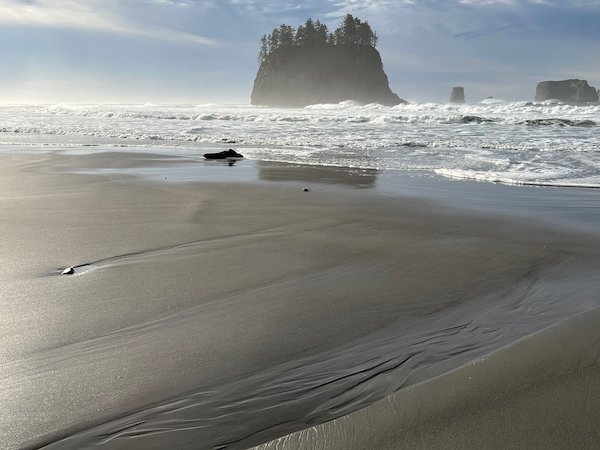
I find myself again listening to the beach, and as with the previous time, I feel like letting the place speak for itself. Only now more so.

Words seem frail, as do individual humans.

Often, my photos follow a stem thought, a particular noticing that compounds on itself, in the form of a series. The thought on Rialto Beach, which is an astounding place to beach-listen, came after attempts to transcribe the waves….

shoo-aaah …. hmmmm-wah …..

ooooorr - rehhh …. brrrr-oh…wa …

prrrr-woh ….. sheeeeeeeeee ….

kraaaah …. kssshhh …. kraaaaaw

And the thought was, that all my countless written syllables, in all my notebooks, in English, German, French, or attempted bird-tree-sea-wind-wave languages, are nothing to the simplicity of stones in sand, the sea’s soft drag ever again recurring, whose writing was expressed all over this wide morning beach with an aching delicacy of line.

My wish is only to make/craft a response that says I am listening. This may be the whole point of all my writing and making: to say I’m listening, to immerse in the learning that is available to me, surrounding me in nature and textiles and all these living beings.

And P.S. - the sinuous lines of trees, also taking my breath and words away…

tags: beach, poetry, quiet, language, stones, sand, nature, tide, winter
Sunday 12.17.23
Posted by Tracy Hudson
Comments: 1
 

beach listening

I used to think that as an artist, I needed to DO something when I saw and felt a beautiful or powerful scene. That I needed to make art from that specific view or immersion or feeling.

But now I know that it’s more important to just be here with whatever is going on, to pay attention with all senses, which today felt like listening.

At some points, it was actually sound-focused, as when I reached the outermost curve of the point, and the gentle waves approached from my right, passed in front, and continued to my left - a wraparound sound of sea caressing small stones.

Or when I heard a distant peeping on the water, higher than gulls’ voices, and could see lots of tiny bird shapes in the distance. The app on my phone suggested they are Marbled Murrelets, a few of whom I did see close enough to recognize. Yes, they are as sweet looking as their names sound.

self portrait in wet rock - this one almost came home with me - those lines!

Generally it was just a form of attention, the sounds joining the light on water, the shapes in the sand, the language of the tide and the shore, and I listened to see what it might teach me.

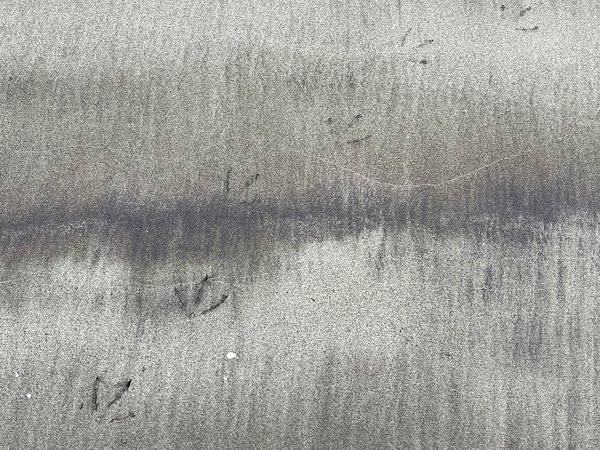
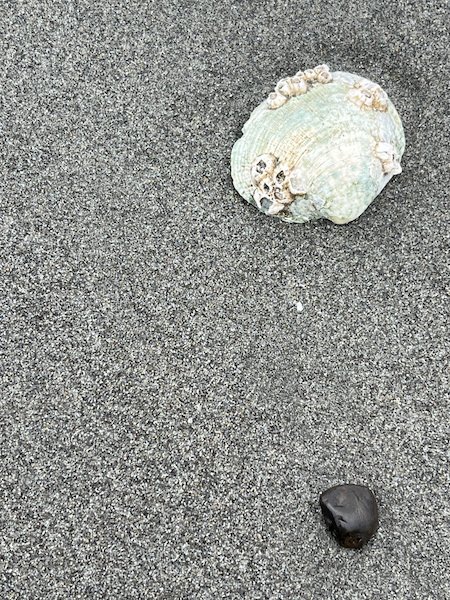
the color and texture of the sand are striking me now, whereas when I made the picture it was a neutral ground for the shell and stone

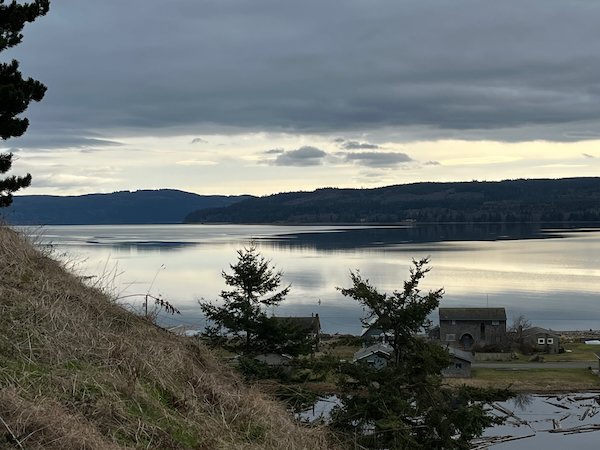
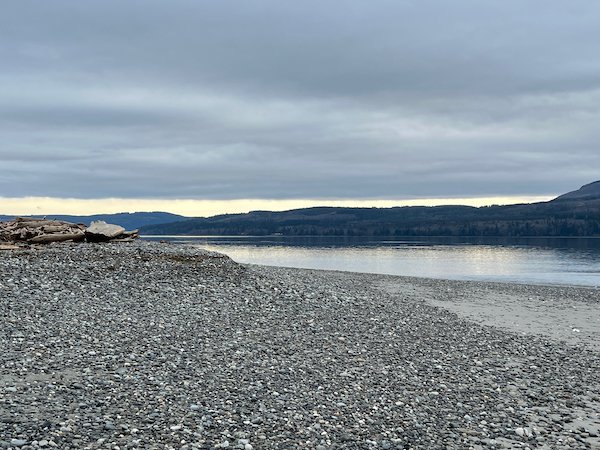
In addition to reminding me that I don’t have to do anything ‘with’ this (but who can resist taking pictures when the colors and textures and shapes are so cool), the teaching today was that wherever I am is the view that matters. I’m often seeing the bay from up the hill, and thinking oh I have to get down there! But the truth is, I can only see the angle of light and reflection, for example in the first image, from just that point on the hill. So I stopped there long enough to appreciate that this view is unique to this spot, before continuing on. There’s some broad lesson in there, that the view from where you are now is unique and most important. It makes me slow down, which has to be a good thing.

I can’t claim to understand the heiroglyphic messages in the beach debris or the designs of rocks, but I have a priority these days of listening to wise language, whether I know what it means or not.

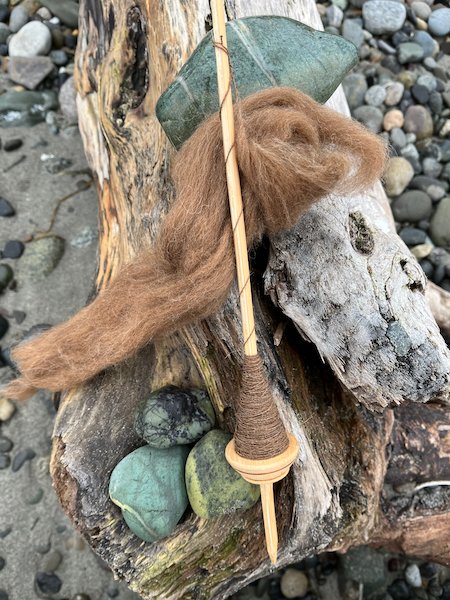
bonus spindle content, with green rocks to swoon over

tags: walking, beach, stones, sea, spindle, spinning, decolonize, slow
Thursday 01.26.23
Posted by Tracy Hudson
Comments: 2
 

surroundings

I've been noticing the harmony between what I'm seeing outdoors and indoors these days.

Hmmm, this could become a habit....

tags: beach, wood, wool, knitting
Thursday 08.27.15
Posted by Tracy Hudson
 

Powered by Squarespace 6