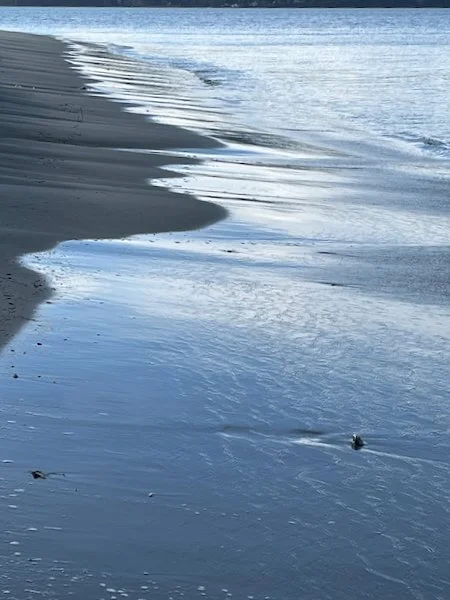
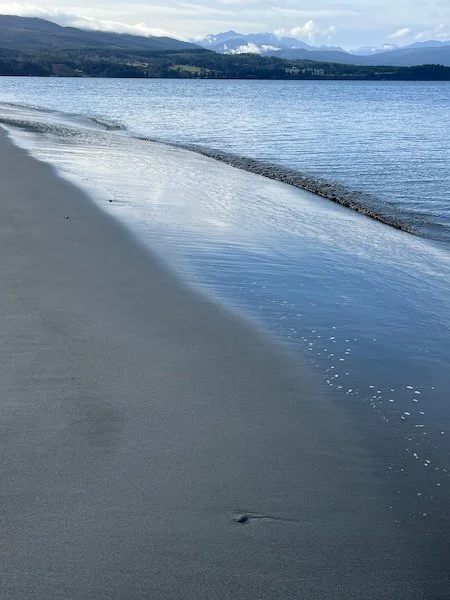
Receding wavelets’ shimmering smoothness
Walking on the winter beach a couple of months back, I was thinking of previous experiences and what I wrote about them. I went to search for these writings, by typing in the title of my website and the word ‘beach’. (This is the easiest way to find something in here, if you can remember key words - pair them with ‘einesaite’ in a search, and it will find posts that include the keyword, or that use that tag.) This time, I forgot to add “-ai” to the end of my search, which removes the automatically generated AI results (and, I can only hope, reduces the environmental strain by a drop), and so I got the following overview: ‘“Einesaite” appears to be the name of a blog/website focusing on nature, poetry and textures (forests, landscapes etc.) not a specific beach itself.’ Of course, I hadn’t realized it looked like I was searching for a beach named Eine Saite. What intrigued me though, was that this machine-guided language hunting determined that my blog is about “textures.” No mention of textiles, or weaving, which is interesting, but - textures. Yes, this is a blog about textures, more often than not.
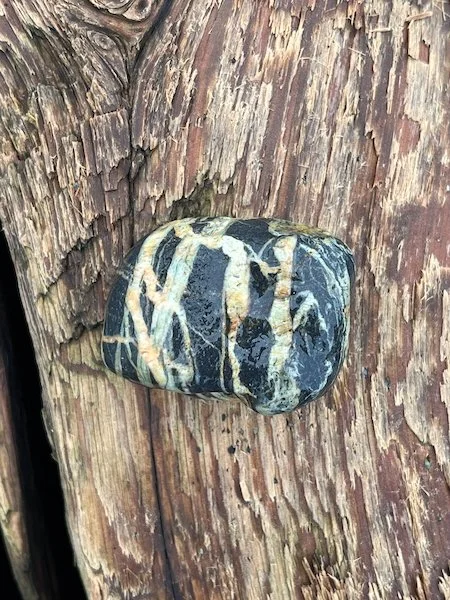
Rock surface and bark surface interacting
I wrote in November last year, “Today every detail looks sharp and eloquent, each texture speaking its richness, particular and wise.” I think about texture most of the time - it’s inherent to fiber work and collage, and garden work, also just the work of seeing, noticing, differentiating.
I think about how a lack of texture is presented as a good or desirable thing, especially in this time of digital enhancement, the increased capacity to erase anything considered faulty or blemished in a surface or image. Something Bayo Akomolafe said about industrialization in an interview on the Emerge podcast comes back to me: the land “was smoothened and flattened, and all the sacred & bumpy and groovy places were rejected and pathologized.”
This process continues, with newer products smooth, slick, frictionless - as our bodies are also supposed to be, advertisements tell us: no snags, no ripples, no bumps or wrinkles. A perfection of limbs based on Barbie doll ideals and supermodel svelteness, all of which denies the reality of growing, which makes marks. Bearing children, being chldren, interacting with a tangible world that leaves scars in undramatic ways - a stray spark from a fire, a brief moment of inattentiveness in a kitchen, a young animal’s scratching, biting exploration of their world - all of this makes marks, leaves behind a language of experience which the digital ideal would smooth away. Give you instead the countenance of an anime hero, large-eyed, pale and smooth, sword-wielding and scarless.
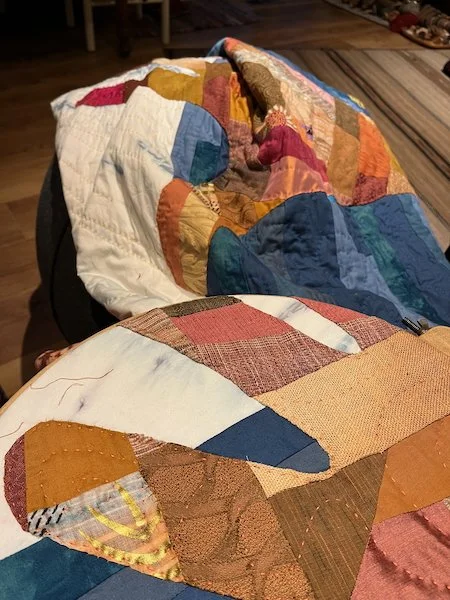
Lap view of quilting in progress… large appliqué hands reach out
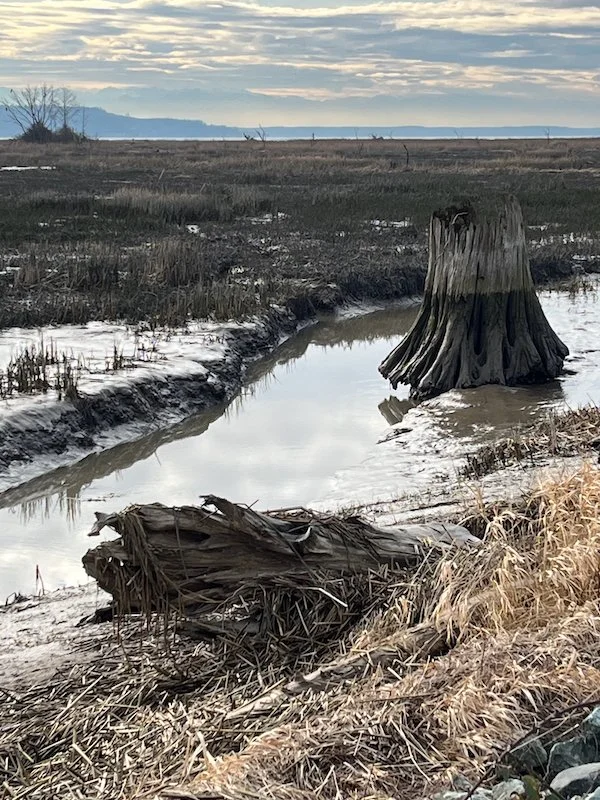
Textured winter estuary, Skagit Bay Wildlife Preserve
This comes up for me when reading or watching futuristic fiction, where people in outer space live in rounded, smooth-walled spaces and plant or animal fiber clothing is a thing of the past. I can’t help thinking it’s a textureless fantasy promoted by those who would “smoothen and flatten” all surfaces. Never mind the kitchen, the laundry, the garbage, the need to rake leaves or shovel dirt - your texture-free existence spares you all that! But how would that actually work… and is it any wonder that people disassociate or feel untethered when faced with this so-called ideal? We need grounding in those textured activities, the scratchy and crumbly and ragged-edged reality of the natural world. I’m not going to cite studies or expert analysis - you know this. You know that to get your hands dirty in soil or sand or clay, to simply hold a stone, or a cat, or a ball of yarn — it helps. Something real asserts itself, and you feel more alive, and more a part of everything (rather than apart from everything). You feel the texture of something, and you feel the texture of yourself.
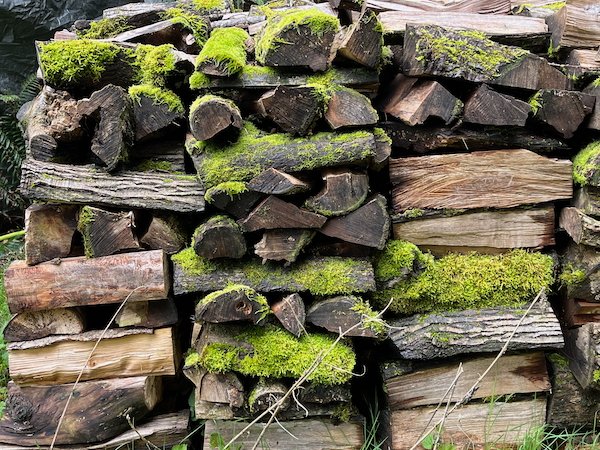
Mossy firewood stack, speaking its own language
The friction of your interaction with the world — even against the air, or in water, or walking on asphalt, that point of contact is never utterly smooth or frictionless. (I remember in Physics class, our teacher had to specify that certain things were occurring on Frictionless Pond, in order to use equations that could disregard the variables caused by friction. The point was, it doesn’t exist.) Friction is always there, it defines our participation as a body. Your texture is your language of interaction with all that surrounds you.
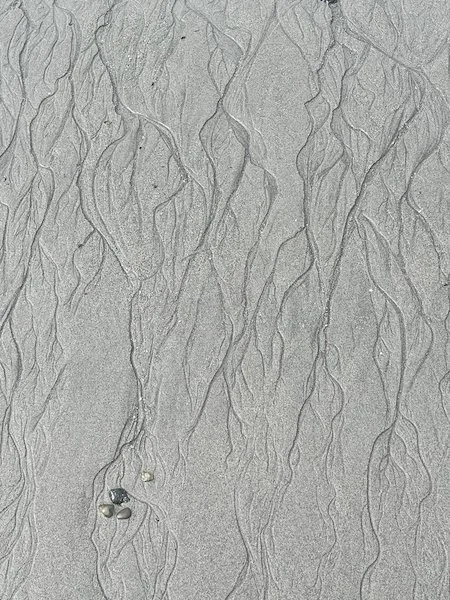
Tide trails on the sand, like tiny rivers.
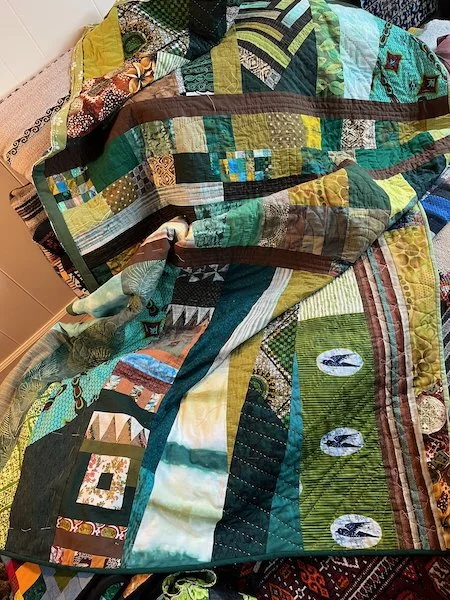
Another quilt in progress, quilted lines furrowing the surface
Your texture is what I love about you; it is who you are.
Pablo Neruda, in “Toward an Impure Poetry,” wrote:
The used surfaces of things, the wear that the hands give to things, the air, tragic at times, pathetic at others, of such things — all lend a curious attractiveness to the reality of the word that should not be underprized.
In them one sees the confused impurity of the human condition, the massing of things, the use and disuse of substances, footprints and fingerprints, the abiding presence of the human engulfing all artifacts, inside and out.
Let that be the poetry we search for: worn with the hand’s obligations, as by acids, steeped in sweat and in smoke, smelling of lilies and urine, spattered diversely by the trades that we live by, inside the law or beyond it.