• spindles
  • textiles
  • works
  • research
  • blog
  • about
  • publications & resources

eine Saite

  • spindles
  • textiles
  • works
  • research
  • blog
  • about
  • publications & resources

drought tolerance - notes from August

(from 20 August 2023, during a time of practice encouraged in the book Poetry as Spellcasting)

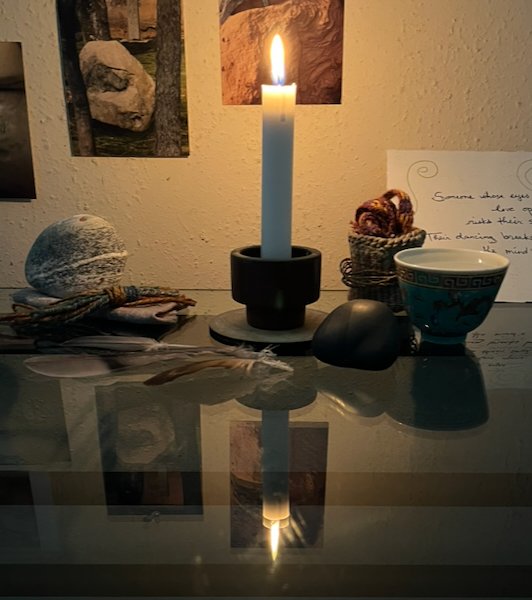
In the smoke of so many wildfires, I still light a small flame, to honor the element of fire, to acknowledge my relationship with this inscrutable source of heat and light, this relationship that does set humans apart — the ability to invoke fire, tend and use it. And will humans ultimately be destroyed by an excess of heat, having become too greedy with this knowledge and ability?

Is there any way to dial it back enough to simply live well, in some mode of harmony? That is the prayer in this candle and practice — a wish to be able to live well in relationship to everything around. The daily offering of water and flame activates an observance of our interdependence, these elements and the life I call me.

The smoke and drought make everything feel stark and struggling.

Breath and moisture are life, and 

drought-tolerant means 

knowing how to rest, 

how to slow essential processes 

to wait for the 

right conditions for flourishing
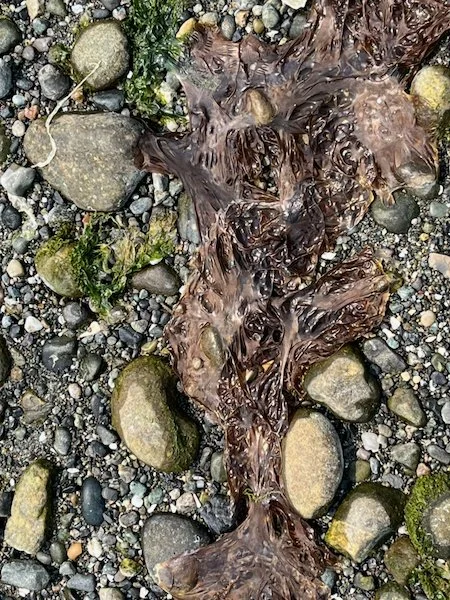
Rilke: “Künstler sein heißt: reifen wie der Baum, der seine Säfte nicht drängt und getrost in den Sturmen des Frühlings steht ohne die Angst, daß dahinter kein Sommer kommen könnte. Er kommt doch. Aber er kommt nur zu den Geduldigen, die da sind, als ob die Ewigkeit vor ihnen läge, so sorglos still und weit.” To be an artist means not to count or reckon but to ripen like the tree that does not force its sap and, trustingly, stands through the storms of spring without fear that summer will not come. It will come. But it comes only to the patient ones, who stand there with eternity stretching around them, quiet, vast, and free of worry. (Letters to a Young Poet, 23 April 1903, Barrows & Macy translation)

For Rilke, summer is the rich and ripening, fruitful time, whereas in my forest garden, the summer (from July onward) is drought and the time of patience.

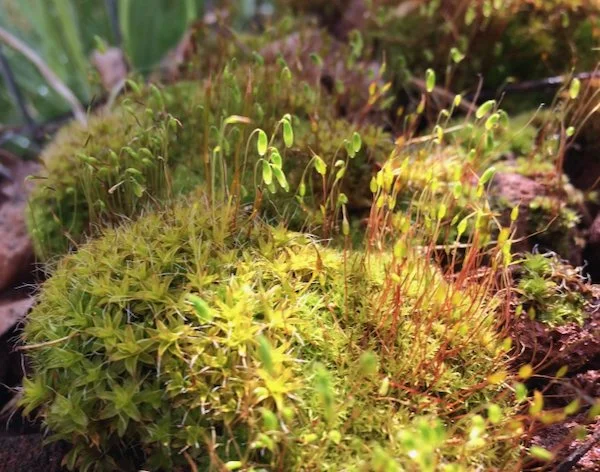
The notion of drought tolerance, learned from observing mosses, combines with Rilke’s poem from the Book of Hours (II,1): “jetzt mußt du in dein Herz hinaus/ wie in die Ebene gehn” — now you must go in your heart out, as into an open plain.

It’s a going inward and an opening out, the open plain is found in the heart. There’s a deliberate sinking into the interior, a dormancy that is not sleep or shutdown, but activated choice, exploration. It is Kevin Quashie’s sense of surrender: “a giving into, a falling into self” and Audre Lorde’s “when we begin to live from within outward…then we begin to be responsible to ourselves in the deepest sense,” and the guidance I took from them to “surrender to the vastness of inner fertility.”
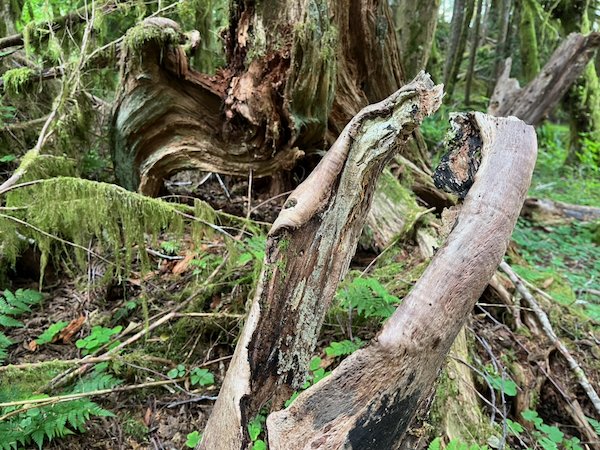
Forest shapes, trees inside out

The edge or seam (der Saum, another favorite word of Rilke’s) of the senses, which is the overlap of interior & exterior, where we balance to gauge what is needed for flourishing.
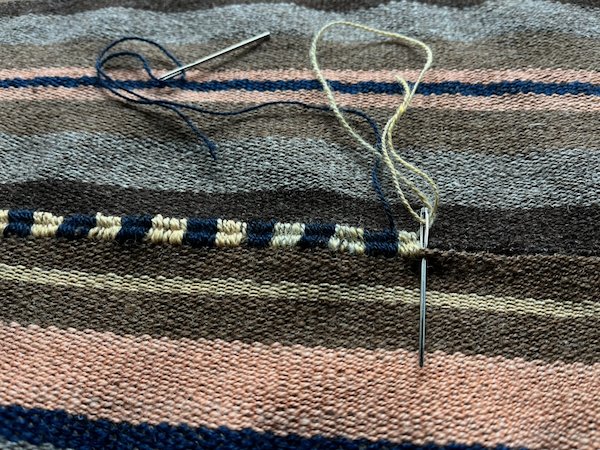
Speaking of seam, I’m working on the last two seams joining these narrow backstrap-woven pieces.
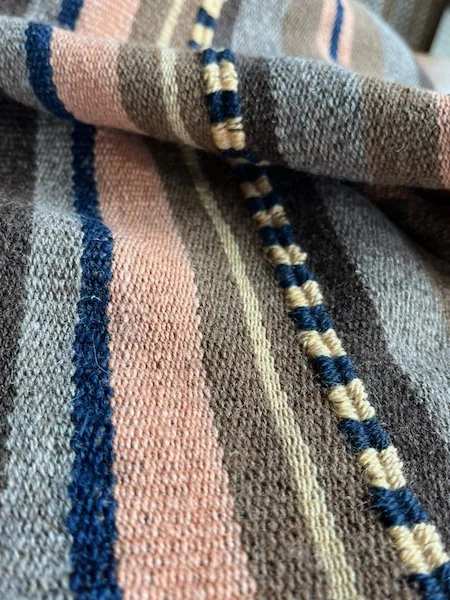
Handspun, handwoven cloth made of joined strips
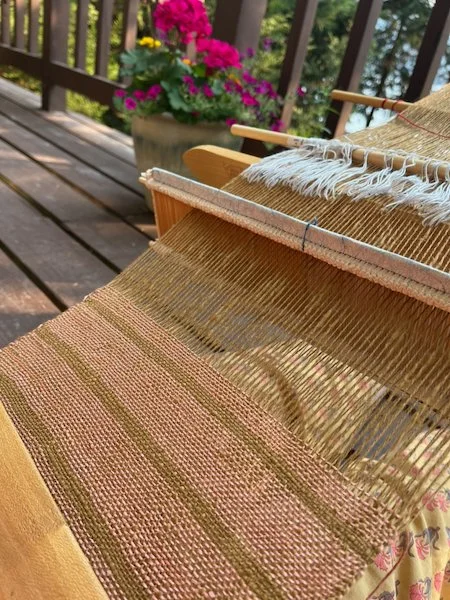
Current weaving, cotton and hemp cloth for the kitchen

Dormancy     as skill of waiting

and also actively sensing

             heightened attention at       the border of

inner and outer                der Saum, like a sewn seam, overlapped

what is the balance of interaction at that seam, what needs to flow

in or out, open pores or close

    breathe in or exhale

                       or hold   that    breath

                                                            protect and/or immerse

my waxy coating and stomata can do both

attuning across this         in/out

                                                  passage, adjusting equilibrium 

to close up          when opening is a danger

       and to risk expansion when

                the scent of beloved invites                         (August 2026)
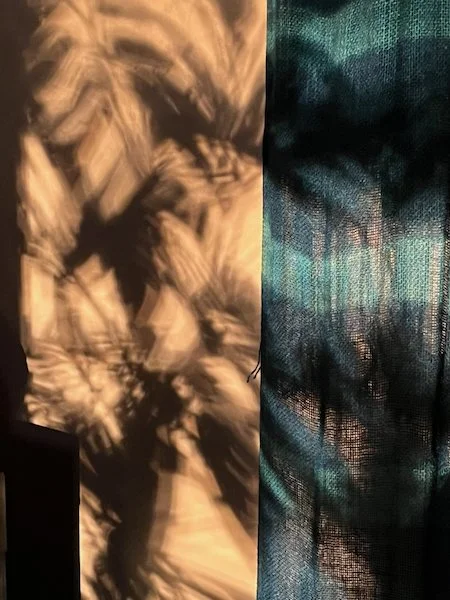
Evening light and wind making broken rhododendron shadows on the wall
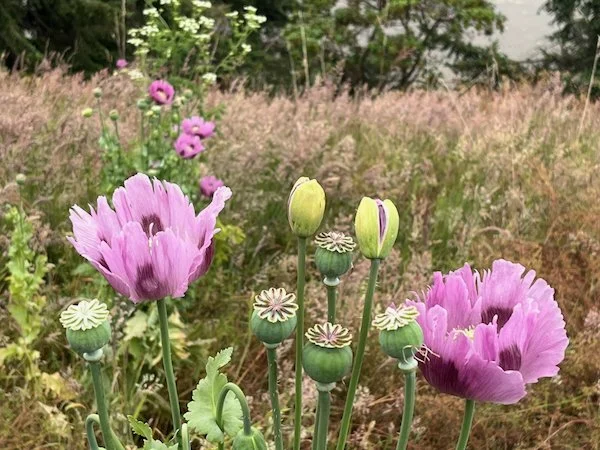
Poppies - ok, this happened before August, but their shapes and colors, against the grasses…!

Rilke: “in deinen werdenden Tiefen zu tauschen,/ wo das Leben sich ruhig verrät” - to plunge into your developing depths, where life quietly reveals itself (Book of Hours I, 14, my translation)

sinking, submerging, pooling, — entering into the silent space of potential with open receptiveness …also related to ‘sich sein eignes Dasein ausschöpfen’ - to scoop out one’s own existence, oneself, to the very end (Letters to a Young Poet,12 Aug. 1904)…. the open resonance within, ‘Geigenleiber, von murrendem Dunkel voll’ - violin bodies, full of murmuring darkness

The waiting that is not only waiting, although patience is paramount — one is participating in growth and unfolding, invisibly. It’s going on at the depths, but not without attention, deliberate and conscious surrender (to the vastness of inner fertility).

So dormancy, patient waiting, is a skill, and the living being has to be attuned to the subtle shifts in external conditions as well as the pace and processes inside. It’s a balancing on the edge, the hem, the seam, of one’s own senses, learning to know the interaction of interior and exterior, what is needed for flourishing, not just in terms of given conditions but also action, commitment, when to burst forth or flow, or reach and stretch. 

(24 August, 2023)
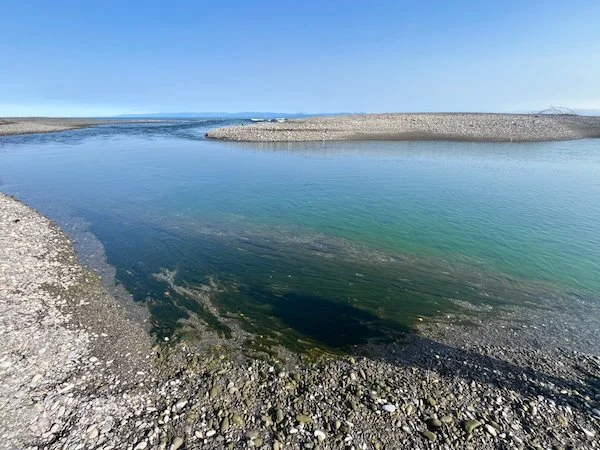
Where the liberated Elwha River meets the sea (I’ve visited and mentioned Elwha many times, and was surprised to see that the last time also included notes about Kevin Quashie’s book.
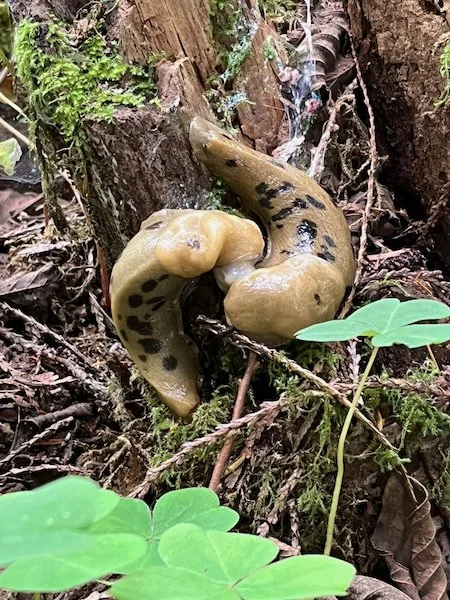
Banana slugs mating and making the sacred symbol of the heyiya-if, from Ursula K. LeGuin’s Always Coming Home
tags: rilke, poetry, moss, environment, forest, water, elements, poetryasspellcasting, ceremony, decolonize, weaving, backstrapweaving, backstrap, handwoven, handspunyarn, stitching, river
Thursday 08.13.26
Posted by Tracy Hudson
 

in which things become (more) cosmic

Forest floor richness, Lake Quinault

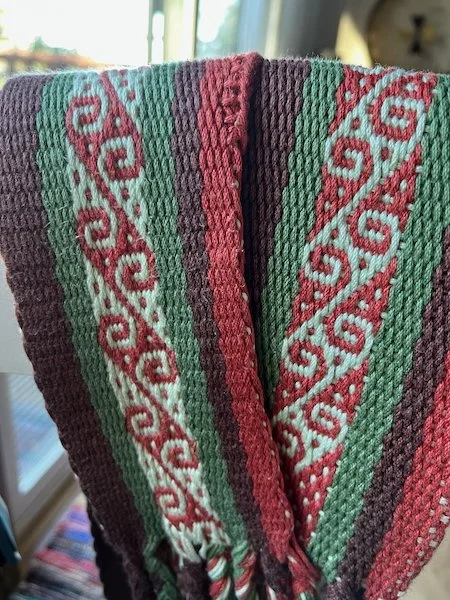
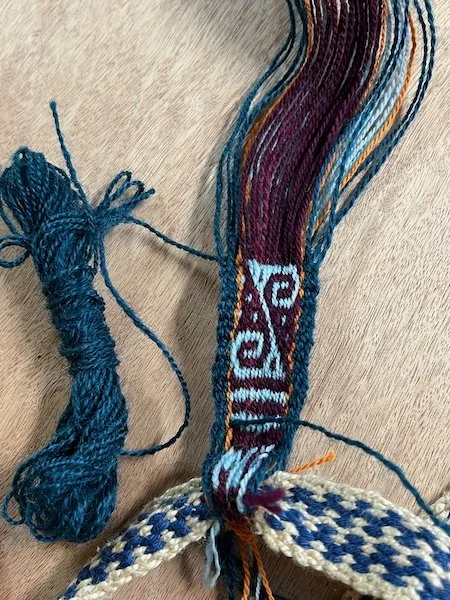
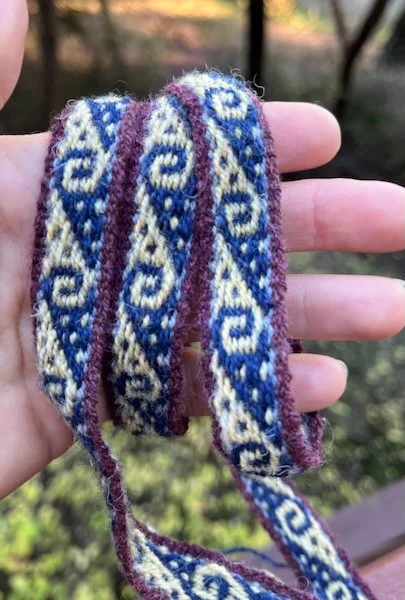
I’m weaving “jakaku sisan”, that is, an Andean weaving pattern with a pickup technique, worked on 16 pattern threads, which takes a basic narrow pattern and doubles it. The doubled pattern is also rotated in this case, so that the two sets of pattern move in opposite directions (I say move because it looks like a wave, and I feel a movement in the direction toward the spiral part.) What mesmerizes me about this pattern, though, is the completeness of the intertwining, the way the shapes made by the contrasting colors cannot be separated. Particularly in the simple band, the width of one unit of the pattern - the two colors are identical interlocking shapes. The doubled pattern introduces another shape formed by the rotation, but it still feels utterly inseparable to my eyes and mind. What I mean is that this mind which is trained to see ‘figure and ground,’ which tends to interpret many Andean patterns that way, even though that’s not how they’re seen within the weaving culture - that mind is overridden or bypassed by this pattern. It sneaks behind my consciousness and says “look, there’s no shape + background, it’s all just one, integrated thing.” This pattern has always been compelling to me for this reason.

The basic curl (sakas) pattern, woven recently with spindle-spun wool

Jakaku sisan, woven more than ten years ago (YouTube link to a former self) using a chart, with Tahki Cotton Classic yarn. This is one band, folded and stitched to make a backstrap - the pattern is the same with colors reversed on the back. Here’s a closer video, although the quality is not great.

In a teaching packet from a weaving workshop, Abby Franquemont describes the pattern like this:

A jakaku is a bird, like a hummingbird. They like to go for the sisan part of the flower, and for flowers where you see the sisan. It has curly bits. And a jakaku will stick its beak right in there.

Which I may have seen before, since the workshop was in 2018, but I did not read or really take in this bit until recently. Like a mystic poem or a koan, it struck me just when I was ready, ringing loud with gleeful resonance. The bird and the flower, interlinked and reciprocal - yes, the pattern says just that! And not just bird & bees & flowers, but this highly evolved, very particular type of bird, the hummingbird with the long beak and long tongue and the flowers that court this bird’s attention with their complex shapes and curls.

It makes me think of the astounding specificity of adaptation, how it’s almost an act of love, how a creature so intricately responds, over time, to a plant and vice versa. How one organism reveals itself to be part of The Organism, this wholeness, in its intimate adaptation to a particular curve of shape or attitude of presentation… Like dancers who bow to one another, implicitly saying I know we are different and that I will make minute adjustments to fit myself to you for this movement… we belong together but we do not exactly match, and so I will be alert and responsive to our interactive shape, brining enough of myself to enhance the sum - the sum of our meeting, which uplifts and exceeds each of us. This dance, continuous in the extended, fractal details of nature, giving promise or potential to each mutation, each irregularity a possibility for transformation into something “fitter”, that is to say more suited, more at home where it lives.

So yeah - that image took off for me, and fits precisely with the wholeness of my perception of the design, the inability to separate the interlocked shapes. This is how the world works: all together.

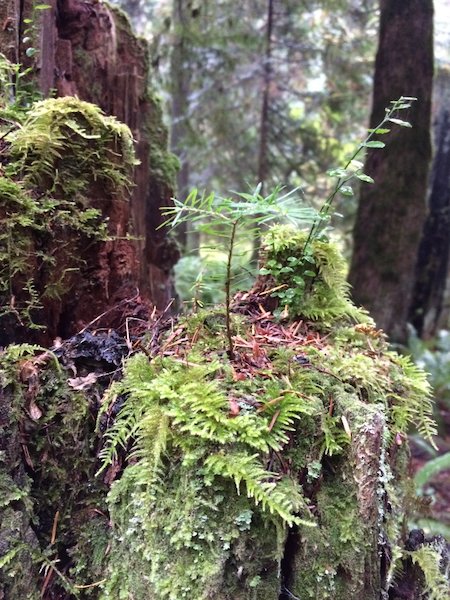
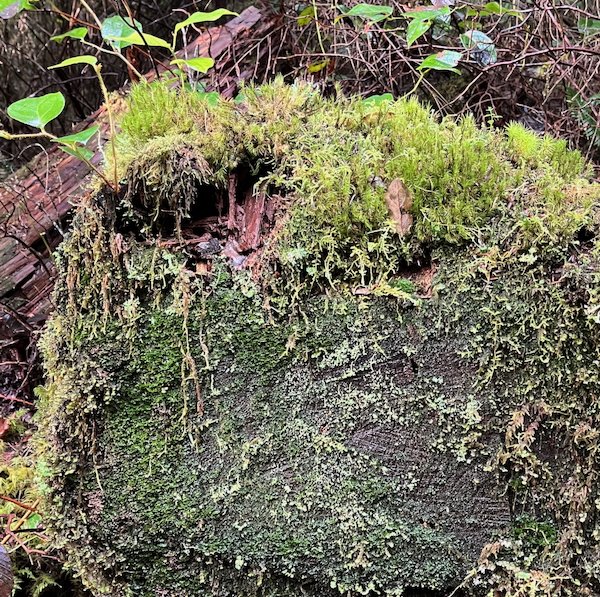
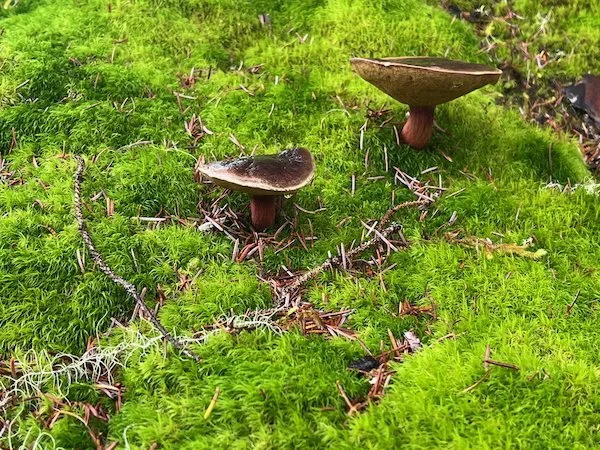
Although I have close relations with hummingbirds these days, I don’t have photos. I was thinking forest stump life demonstrates a similar level of reciprocal co-evolution and intertwined existence.

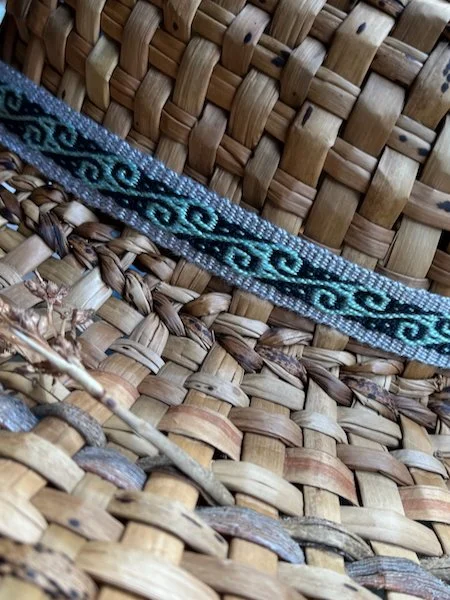
Jakaku sisan band, woven recently with #10 crochet cotton, without using a chart, shown as a band on my handwoven bullrush hat.

It’s like going from writing to storytelling or singing, the difference between weaving from a chart and knowing the pattern by heart. I knew when I first started that this was an essential step in weaving Andean pickup, and traditional techniques from other cultures as well. The weaving is learned with the hands in communication with the heart/mind, and while using a chart helps us make the correct designs appear in our weaving, it does not give us the same kind of learning. This understanding made me resistant to charts, but I also didn’t have the patience to weave dozens of bands with the basic patterns again and again. I am a reader and a writer and, by my placement in the world and time, a dabbler in weaving rather than an integral element of a living tradition. No one is relying on me to weave a thing so they can use it, to learn the patterns of my village or clan or lineage correctly so that I can represent us with skill and pride in the clothing I wear. So I had the freedom and luxury to try various patterns before I had technically worked up to them, to use charts and “book learning” to skip ahead of the language I had memorized. But I did not forget the value of, or my desire for, the type of learning that moves through the body, that embeds itself in the joining of hands, mind, eyes, fingers, memory, recitation.

When I say I’m weaving this pattern now, I mean I’m learning it by heart, weaving it until I know it.

Jakaku sisan, woven with spindle-spun wool. This band began without reference to anything but my memory. Update Feb. 2026: I just made a video of myself weaving this one, since the previous video is so old and grainy.

It’s fitting that I’m working this way as I learn and memorize Persian poems, as I reiterate those of Rilke I know from memory, finding the ‘king lines’ in both and carrying them with me. (The shah beyt, the ‘king line’, is the part of a Persian poem that resonates, that carries the most compelling message, worthy of memorization and repetition like a mantra.) The jakaku sisan pattern has its own shah beyt for me, a point at which the numbers (of light and dark pattern threads) balance perfectly, in a mirrored sequence, like a hinge where the movement rotates and radiates. It’s not an actual rotation point of the design, what is known as an “eye” (ñawi), but it speaks to me of the spiral intertwinement of the curls, the balanced reciprocity of color, woven thread structure, and cosmological patterns. In short, it feels like the secret of the universe is in this pattern, which makes weaving it feel like devotion, and learning its language by heart an essential participation in the reciprocity of all things.

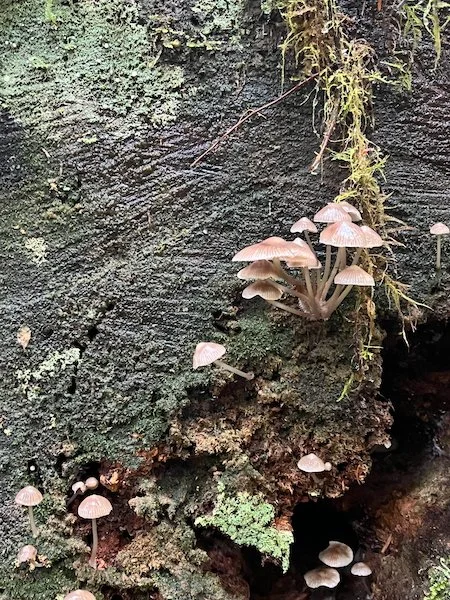
More stump life, from Quinault Rainforest on the Olympic Peninsula.

tags: weaving, backstrap, backstrapweaving, andean, andeantextiles, andeanweaving, mushrooms, moss, forest, hummingbird, abbyfranquemont, pebbleweave, reciprocity, forestlife, poetry, persianpoetry
Friday 11.28.25
Posted by Tracy Hudson
Comments: 1
 

what to say

Walking alone in the Hoh Rainforest, thinking and reflecting brought me to the following burst of thought. I put it here essentially unedited - all you need to know is it came from walking the Hoh River Trail, near sundown in October. It came of solitude and unrestrained ramblings of the mind, and I feel it’s time for less editing, more blunt speech.

I find myself increasingly fed up with the presumptions I absorbed due to the culture I was raised in . I can't figure out why they persist, because not only are they incorrect, they don't serve us. They cut us off from the very approaches that could heal our relationships on earth.

I'm not saying throw out Western science - but throw out the idea that there is one right way to understand, that rational empiricism is the undisputed path to the truth. And I'm not just saying there are ‘many paths’, but rather, there are truths that require a variety of listenings.

We have been taught to detach, detach, detach - and what does that give us? How does it benefit the living systems of the earth if we extract ourselves and claim an (artificial) separateness?

If anything, increased understanding of molecular biology and organic chemistry should give us more confirmation of our own integration into these immeasurably complex systems.

I feel a part of it - I am integral to the whole thing, and any attempt to hold me accountable to an opposing viewpoint based on my color, culture, or upbringing is simply another form of divide and conquer.

I won't be divided from this. I won't tolerate it anymore. My family is in the rivers and forests - my veins flow with the same logic and magic, my breath is all breath.

tags: forest, ecosystem, science, environment, olympicnationalpark, bryophyte
Sunday 12.15.19
Posted by Tracy Hudson
 

forest river texture

The first two have been lacking in my life lately, although texture has continuously been there. And I noticed texture was one of the most striking things about being back in a forest. The view below was beneath my feet as I sat on a rock.

The river itself is multi-textural, rushing through the rocks and eddying near the shore. This river, the Elwha, has a remarkable story that is in dramatic progress, with imminent and unpredictable change in its future.

In fact, the hike we did may be inaccessible once the waters rise, so it was a privilege to see the place as it is now. But mostly we were in the forest. It stuns me how quickly one is in the forest on the Olympic Peninsula.

Every tree has a different texture, from its own bark and from all the licheny, mossy, fungal growths happening.

There's not much to say when dwelling in this sort of world, but I wanted to share a few images, as well as the Elwha story.

tags: elwha, river, forest, moss
Tuesday 08.04.15
Posted by Tracy Hudson
Comments: 2
 

Powered by Squarespace 6