• spindles
  • textiles
  • works
  • research
  • blog
  • about
  • publications & resources

eine Saite

  • spindles
  • textiles
  • works
  • research
  • blog
  • about
  • publications & resources

spindle, bobbin, shuttle

IMG_7898.jpg

I started out weaving this with a two-ply handspun, churro and Icelandic. But the sett is too close with this reed, and the weft did not show through enough and I didn’t like the result, so I tried the churro singles. It was still on my spindle, and I discovered that this particular spindle (from Allen Berry) is of a length and whorl shape that works perfectly as a shuttle. Convenient! And I like the look of this weft, so I just kept weaving with the spindle as shuttle. Allen, who also carved the beautiful yellow cedar sword/beater, mentioned that he’d heard of people using spindles as bobbins/shuttles before, and this rang a faint bell for me, too. I knew I’d definitely seen people winding a warp directly from full spindles, and I found the video: winding a warp directly from spindles, in Western Ladakh.

It does sound familiar, though, putting a spindle into a shuttle as bobbin…. maybe a quill spindle, for cotton…? I can’t remember where I saw or heard of that, but pipe up if you know anything.

At any rate, I’m enjoying having a plain weave project with the reed on the loom again, and this time I’ve wound the far end, so I can weave a longer length without dealing with the full weight of a 3+ yard warp between me and the loom bar. Seems to be going ok. I have tension issues, but what else is new?

IMG_7900.jpg
The lovely Navajo Churro fiber I’m spinning. It was a gift from Amelia, who got it from someone else, so I can’t say much about the provenance. This (beautiful Peruvian) spindle does not work as a shuttle, so I have to wind it onto a bobbin, but usi…

The lovely Navajo Churro fiber I’m spinning. It was a gift from Amelia, who got it from someone else, so I can’t say much about the provenance. This (beautiful Peruvian) spindle does not work as a shuttle, so I have to wind it onto a bobbin, but using it allowed me to spin while weaving with the other spindle.

Otherwise, I’m working on the opposite end of the spectrum from plain weave - trying to wrap my mind around a pattern and technique that have been calling to me for years. It’s the typical Central Asian yurt band weaving, which Laverne has graciously explained in various tutorials, under the name of “simple warp floats” (simple because they float on one side only, the top.) I’ve had those pages, and this one, bookmarked and screen-shotted, and photos copied and printed since she started posting about it back in 2010. For some reason, the yurt bands have always grabbed me, and I knew I would have to figure it out someday. Yes, Laverne has explained it nicely and given plenty of ways for it to make sense - BUT, the actual translation of woven pattern to chart, especially with the Central Asian tendency to stipple the background, is really quite challenging. That final link, where Laverne made a wide piece with pickup in foreground and background, has just always thrilled me.

Sample with striped (plain weave) background.

Sample with striped (plain weave) background.

Note that in the tutorials, the background remains striped, which is plain weave with no pickup. Doing pickup on the whole surface is another ball game, and a very different one from Andean pebble weave or complementary warp pickup. The designs look similar, especially on the front, but structurally they are a different technique, and the rules for composing patterns are not the same at all.

I found out how different, and what some of the rules were, while trying to chart a section of a yurt band pattern, based on a printed photo of an actual band belonging to Marilyn Romatka.

Warning: this could hurt your head….

Warning: this could hurt your head….

Marilyn Romatka’s yurt band, about 13” wide by 15+ yards long.

Marilyn Romatka’s yurt band, about 13” wide by 15+ yards long.

I was still daunted by the wide yurt band patterns, but I really wanted to figure it out. Recently, circumstances came together that allowed me to sit down, look at Laverne’s images once more, and take on the pattern. I charted a quadrant of a symmetrical design, and started weaving a half-width to test it. So far, it’s working!

One repeat of the design. I took out a couple of rows to correct the vertical mirroring point, but now I think that’s figured out. Cascade Ultra Pima cotton yarn - it’s what I had handy.

One repeat of the design. I took out a couple of rows to correct the vertical mirroring point, but now I think that’s figured out. Cascade Ultra Pima cotton yarn - it’s what I had handy.

I’m continuing to look at the yurt band photos and trying to understand more of the typical patterning, so that I can create border designs in narrower strips. Spending my morning on this kind of thing is deeply gratifying, in the way that finally being able to weave something one has admired for years can be. The next effort at this will be with handspun wool.

Trying to chart border patterns from this image and from Marilyn’s band….

Trying to chart border patterns from this image and from Marilyn’s band….

The yarns I have in mind.

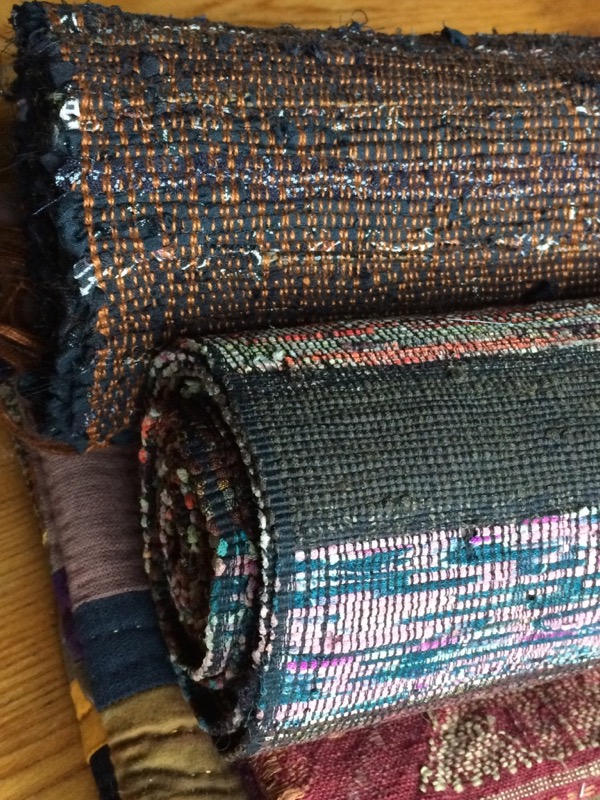
The yarns I have in mind.


tags: handwoven, backstrap, backstrapweaving, backstraploom, bamboo, handcarving, spindle, handspinning, handspun, weaving
Thursday 02.28.19
Posted by Tracy Hudson
Comments: 6
 

sakiori pictures and unrelated thoughts

IMG_7517.jpg

Some unwonted, taught pride diverts us from our original intent,

which is to explore the neighborhood, view the landscape,

to discover at least where it is that we have been so startlingly set down, if we can’t learn why.

- Annie Dillard, Pilgrim at Tinker Creek

My sakiori (behind) with a traditional Japanese piece.

My sakiori (behind) with a traditional Japanese piece.

I read Annie Dillard and feel urgent, often. Her sense of duty is compelling, and it motivates me. But it motivates me to very minimal actions, since the imperative is, as I’ve mentioned before, to pay attention. To look, to see, to witness. In another passage, she writes of seeing a bird dive in free-fall before deftly landing on the grass: everyday, commonplace, and extraordinary. She concludes that “beauty and grace are performed whether or not we will or sense them. The least we can do is try to be there.”

So more often than not, her words compel me outdoors, as do Mary Oliver’s poems or Robin Wall Kimmerer’s essays on our participation in this world. Participating, as a seer, a person trying to have what Rilke called “the right eyes,” is a full-time occupation. Unless we get lazy and neglect our duties, which is easy to do. Easy to get pulled into online discussion or news, easy to binge-watch something as an escape from the arduous act of thinking. I try to increase the time away from such distractions (unless the online stuff is truly feeding a worthwhile train of thought, which happens.) I turn to Ursula LeGuin and her mother’s wonderful writings about Ishi, their tragically famous friend. I read David James Duncan and Robin Wall Kimmerer, Tim Ingold and Dr. Leticia Nieto. Most recently I read Elaine Pagels Why Religion?, a gift from my father-in-law who, as a Biblical scholar, has always been a fan.

They are all pointing down a similar road, leading away from colonialism and the old, destructive narratives that I somehow grew up with. I’ve been trying to dismantle that ideological box for a long time, and I keep finding new tools. But it is an uphill trek. For every sentence I manage to write here, there are countless thoughts and potential words swimming around, uncaught and fleeting. At any rate, I’m trying.

The sleying process. Reed is 8” wide, 22epi. (Ok, this photo was in the last post, but here it is again.)

The sleying process. Reed is 8” wide, 22epi. (Ok, this photo was in the last post, but here it is again.)

My first project with the smaller bamboo reed that I made at home, on my own, is a sample of sakiori, a weaving made from torn up fabric. The weft is made of strips of kimono silk fabric. I’ve been preparing the strips for some time, and this is the warp I impulsively wound when I arrived home in December (last post.) It wove up quickly, and was finished in time to show friends in mid-January.

As with most of my weaving thus far, it is nothing more or less than an attempt to make a certain type of fabric, to see how it might be done with my backstrap loom situation. I’m pleased with the result, am interested to work with finer strips of fabric, and do not know what I will “do” with this piece at the moment.

Here’s the setup. Don’t be confused by the rolled up weaving on the floor beneath (extra sticks at the top of the photo.) This one has lease sticks, a fat shed stick, string heddles, two swords and a reed. I had to beat with the sword rather than th…

Here’s the setup. Don’t be confused by the rolled up weaving on the floor beneath (extra sticks at the top of the photo.) This one has lease sticks, a fat shed stick, string heddles, two swords and a reed. I had to beat with the sword rather than the reed to get this packed nicely.

IMG_7583.jpg
IMG_7595.jpg
Need to work on tidying up that selvage, apparently… (actual Japanese weaving on left)

Need to work on tidying up that selvage, apparently… (actual Japanese weaving on left)

tags: textiles, weaving, backstraploom, backstrapweaving, handwoven, sakiori, decolonize
Monday 02.11.19
Posted by Tracy Hudson
 

home again

Whenever I come home from being away, I tend to re-assess, to inventory my projects, ideas and materials. I need to go around and touch things, fluff the space, remind myself of what was going on. At the same time, I tend to be most open to doing something completely new during this re-entry phase. This was the case yesterday. I’m home, only for a week, with warps on the looms, fiber on the wheel and spindles, and plenty of things in some state of generalized progress. But as I moved through my studio space, every corner, bin, and shelf called to me with fresh voices, things that wanted to jump the queue and happen now.

Glancing at these papers in a baskets, I had the urge to use them all, immediately.

Glancing at these papers in a baskets, I had the urge to use them all, immediately.

I see papers and paints and pencils, and itch to pick them up. Then I see fibers lurking in a bag and start to think about enticing new combinations.

Wouldn’t these look great together? Recent acquisitions from Abstract Fibers and Abundant Earth. (I seem to have lost the ability to resize photos in this website, so bear with me as I go from too big to too small.)

What I ended up doing, though, was pouncing on the box labeled Saki Ori, and saying This is it. This happens today. It had been a long time coming. I prepared the kimono silk weft many months ago, maybe even a year ago, I knew what I wanted to use for warp, and I knew I would use my 8 inch bamboo reed. So it was all ready to go, awaiting the moment of ignition. I spent the day preparing a whole new warp, musing on the materials visible through the warping frame as I wound.

New warp on frame, with handspun Nomad Caravan peeking through.

New warp on frame, with handspun Nomad Caravan peeking through.

Sleying the bamboo reed. I think this is 20/2 cotton (unidentified, from a destash sale), and the reed is 22 epi.

Sleying the bamboo reed. I think this is 20/2 cotton (unidentified, from a destash sale), and the reed is 22 epi.

This part is really quite relaxing, if I’m in no hurry.

This part is really quite relaxing, if I’m in no hurry.

And then we’re off and weaving. I’m happy to be doing something new, but also a planned thing: it was on the list, but it has a spark of excitement because I’ve never done it before. I have a beautiful example, an obi that I bought in Japan 20 years ago. Ever since I made the small bamboo reed, I’ve been wanting to weave with kimono silk weft. My silk strips are wider than those in the vintage obi, but this is my first go, just getting acquainted with the possibilities (I have a lot more silk scraps.)

Japanese sakiori obi, on top of a patchwork camel trapping.

Japanese sakiori obi, on top of a patchwork camel trapping.

Work in progress. I find the irregularities mesmerizing.

Work in progress. I find the irregularities mesmerizing.

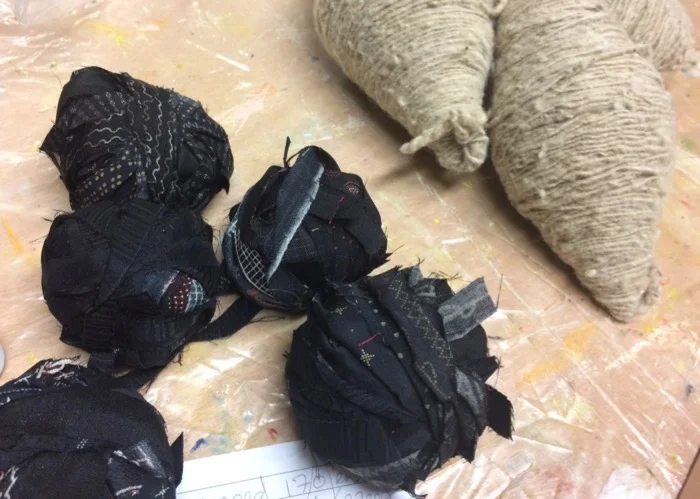
Kimono silk strips for weft, hanging around with some random yarn.

Kimono silk strips for weft, hanging around with some random yarn.

The various vignettes in my studio continue to intrigue: the sakiori weft balls themselves, before being wound onto shuttles, begin to make tentative conversation with some aged handspun cops I picked up at the guild auction. The air hums with possibilities, even as I commit to a single project for hours and days.

tags: handspinning, handwoven, weaving, backstrap, sakiori, kimono, textiles
Wednesday 12.19.18
Posted by Tracy Hudson
Comments: 4
 

in appreciation of small green things

Isn’t it plain the sheets of moss, except that

they have no tongues, could lecture

all day if they wanted about

spiritual patience?

  • Mary Oliver

Hoh rainforest, Olympic National Park

I’m here to confess a preoccupation with mosses. I suppose it was bound to happen, after having lived in the desert for 8 years. I chose to move to the Pacific Northwest because of trees and mountains and the color green. The mere color green, as manifested in plants, had become such an elusive sight that I could look at photos of Olympic National Park online and just cry. That such wealth of green existed, somewhere, was promising. But I dreamed of living there, of being immersed in the green light of reflected leaves, needles and tendrils brilliantly photosynthesizing. I dreamed of moss. Moss all over everything.

So I was primed to appreciate moss, and I have been, but it wasn’t until I heard an interview with Robin Wall Kimmerer and then read her book Gathering Moss, that I realized how little I knew about mosses. Even this plural, “mosses”: it’s a code word showing familiarity and appreciation, for only those who look closely even realize the wealth of variety in what we normally call “moss.” For example, in the photo above, taken in the Hoh Rainforest two years ago, I was thrilled with all the glorious moss, and would have said just that. Now, after only a short period of looking and learning, I zoom in on any patch of moss and start seeing how many different types I can distinguish. Without being able to identify species, I can still see characteristics that I was completely unaware of before. And knowing that there are so many different species and shapes in most clumps of moss, I can no longer talk about them without saying “mosses.”

Common along my driveway. My guesses: Eurhynchium praelongum and Brachythecium populeum

Now, whenever I walk, I take my magnifying loupe to examine the mosses in detail. Sometimes I bring home tiny samples so I can look them up and compare them to others I’ve found. I have a moss notebook for notes and little pressed samples. Using Kimmerer and Annie Martin as a starting point, I look up images by species name, and try to match my samples. The names are lyrical, poetic in their rhythmic syllables, and my language-loving mind and mouth delight in pronouncing them: Plagiomnium ciliare… Brachythecium populeum… Dicranium scoparium… Rhytiadelphus squarrosus. The Latin words sound like an invocation, and indeed, I feel an entering, an opening, as I begin to learn their names. Although the Latin binomials are, as Kimmerer notes, “arbitrary constructs,” they are individual and lovely, “as beautiful and intricate as the plants they name,” and as she also explains, to call a being by name is a sign of respect. (Gathering Moss, p.12)

Three mosses from down the road, all growing together. Kindbergia oregana, Hedwigia ciliata(?), Dicranium… scoparium?

Life on a log in my driveway

Tree in Bloedel Reserve, Bainbridge Island, WA

This process has taken hold of me, and I’m unsure why the urgency, but I’m not resisting. I’m planting ferns in my garden and encouraging mosses to grow among them, but gardening is not my main motivation. No, it has more to do with expanding and deepening my interaction with my immediate surroundings. Making a home here by looking closely, paying attention, learning the details. In trying to distinguish between different moss species (without the aid of a microscope, which would be really helpful,) I’ve been forced to notice the shape of leaves only one millimeter long, whether they have serrated edges, whether they taper at the tip, how they are placed on the stem in relation to each other. All of these factors have botanical terminology, yet another set of new words to learn. But the important thing is seeing it, noticing that how leaves grow tells something about the plant, and that such characteristics are present and distinct even if it takes a microscope to see it. Each living being has so much going on. Then, when I look up and survey the larger world again, I notice and understand more about big trees and other plants, because they are like giant versions of the mosses. It seems that the mosses are teaching me how to see - an unanticipated and very welcome lesson.

I do need to find more people with this preoccupation, since I often hit a wall with my attempts to identify. But the looking is still fascinating, even when I don’t know exactly who I’m looking at.

Four mosses awaiting further examination and ID… Upper right I think is genus Atrichium, and lower right Barbura…. unguiculata?

Moss from the waterlogged rain gutter of my garage. Whatever this is, it loves to be completely wet.

I’m gathering my images into a Flickr album so they are easier to peruse all together.

tags: moss bryophyte garden plants mosses, moss, bryophyte
Thursday 10.04.18
Posted by Tracy Hudson
Comments: 4
 

second annual cedar root class

Progressing from plain weave to pickup

I'm preparing for my second round of teaching an introduction to backstrap weaving through the Cedar Root Folk School at the end of September, and remembering what an enjoyable experience it was last year. This school focuses on sustainable living, with classes taught "hand-to-hand" in an intergenerational, mentoring format. Such a premise attracts students with an interest in skills acquisition. They are coming to learn how to work with their hands in a specific way, for their own long-term benefit, and their focus and earnest attention reflected this.

None of my students were weavers when they arrived, but they all took to it quickly, establishing the rhythm of opening sheds and manipulating string heddles. Very soon they were ready to move on from plain weave stripes to the basic tanka ch'oro pickup pattern.

Mary wove so fast she could not be bothered to advance the safety pin at her waist, to bring the working area closer.

I explained the context of this pattern, that it's a beginner design for young weavers in Peru. These students were interested in all my digressions and side stories, my samples and cultural background notes. We studied images of backstrap weaving from different parts of the world, and they appreciated the range of possibilities sourcing from an overtly simple method.

One student brought some handwoven examples from her own collection, for me to admire and try to identify. I love the band pictured below, although I can't tell its origin - possibly Central Asia?

Warp faced band with complementary warp designs - where is it from?

We had wide-ranging discussions at lunchtime, confirming that these were not just people I was happy to teach, but women I was glad to know. They worked diligently through the afternoon, practicing pickup and warp winding. The next morning were ready to wind wider warps, to weave their own striped backstraps.

Asymmetrical backstrap design - we'll just way we meant it that way ;)

Interesting backstrap designs emerged, and these determined students managed to finish, or very nearly finish, the entire thing that day. Taking home the sticks, sword beater, and handwoven backstrap, they were all prepared to keep weaving on their own.

It was a gratifying class for me to teach, and I thoroughly enjoyed myself. I'm glad to have connected with the Cedar Root Folk School, and I look forward to this year's class.

A subdued design, begun on this backstrap after inserting a card to hold the fringe.


tags: weaving, backstrap, teaching
Wednesday 08.01.18
Posted by Tracy Hudson
 

never too much

Nigerian robe, woven from narrow strips, in the collection of Leslie Grace as displayed at Aljoya Thornton Place

I was fortunate to catch a high quality exhibition of textiles in Seattle while Laverne was visiting - details in the textile blog. The array of cultures and techniques was impressive, and the quality of each piece impeccable. Below is a detail from the bodice of an embroidered Mexican dress.

Mexican dress, collection of Leslie Grace

The floating animals filling in the blank spaces, and the random dog with collar, reminded me of a rug hooked by my Great Aunt Jean. I recently came into possession of this wonderful rug, which looks very Persian to me in its composition and designs - with the exception of a cartoonish black poodle among the stylized birds and geometric shapes.

It makes perfect sense, for someone who owned a black poodle and worked as an artist for Hallmark cards. I find this rug brilliant, so I made sure it came home with me. Apologies for the overbright reds. There's my freeform textile association of the day: pet dogs in Mexican embroidery and American rug hooking!

Detail of Aunt Jean's rug, showing black poodle.

tags: textiles, rug, nigerian, mexican
Saturday 06.02.18
Posted by Tracy Hudson
 

weaving and weaving and weaving

My double weave and supplementary weft samples, surrounded by Laverne's beautiful palette of tencel yarns.

I probably overuse the word "whirlwind" to describe periods of time in my life, so let's say that the last several weeks have been a blur of weaving and textile-related stimulation.

It started with a visit to Kansas City.

Well, it actually started over a year ago when I plotted and schemed to bring Laverne Waddington to Port Townsend for a class. She visits Seattle regularly,  but I hadn't managed to bring her to my home yet, so I drummed up interest in my weaving guild (not difficult at all) and scheduled a day of weaving in April 2018. Getting this all organized had been my focus, as well as family issues, and so when I prepared to go to KC for phase one of family stuff, I was not thinking of fun fiber events or weaving opportunities.

But of course, Kansas City is the new home, for three years running, of Ply Away, and I soon became aware that fate, the universe, and/or the weaving gods had conspired to place me in the perfect position to photobomb Abby's intermediate backstrap weaving class and assist her with a warp-winding method I've been eager to learn for YEARS! I mean, really. I can't express how great this was, particularly for being so unexpected and unsought.

Being Abby's warping partner!! Peak moment, right here.

Watching Abby go through the basics of backstrap was edifying - although this was an intermediate class, she reviewed things like winding two-color warp and making heddles, for the benefit of the newer weavers (those 5-6 year-olds on the Chinchero weaver scale.) I had been advised and coached by Abby over the last 8 years, but had never actually watched her handle a warp, so just seeing how she did pickup, opened sheds, and used her hands and tools was a special treat.

Abby heddles a supplementary warp band.

It was also remarkable to weave with Abby and then Laverne, almost back-to-back. I've learned to weave from these two people, but I'd never sat in a class where they showed beginners the basics before, and in both cases I got to see the teaching method in action and directly compare the styles. Abby is admittedly Chinchero-chauvinist, teaching The Way she grew up learning, while Laverne has amalgamated methods from a variety of traditional weavers in Peru, Bolivia, Chile, and Ecuador, from whom she has learned different techniques. Both of them have experience as educators, and so their teaching is deliberate and skillful, developed from an understanding of progressive levels of learning. This means I got to observe not only how to weave from the student's perspective, but also how to teach, which interests me because I have taught backstrap once or twice, and hope to have more opportunities.

Laverne demonstrates supplementary weft patterning.

Being around newer students, I also saw how the teaching translated into their understanding of how to weave. Abby's students are comfortable with Quechua terms like illawa and sonqopa (heddles and shed stick, which are the only system they use for opening sheds,) while Laverne's students adopt the clever "twisty sticks" (an extra cross held on two bound sticks that is used to help open both sheds), and heddle the alternating "pebble" sheds when using such patterns. The terminology and vocabulary of movement that each set of students picks up is different, but they're all learning traditional backstrap weaving and it's brilliant to see weavers growing up.

I've felt pride in being able to weave in this way, since I began in 2010, and having my skills confirmed by my teachers gives me a thrill of confidence, and motivation to keep growing. It has been intense, having so much exposure to my weaving people. This is a precious community we're creating, and I hope to nurture it.

So that's the overview. Then, there was the stuff I actually learned, and the whole process of absorbing the information. I got a lightning-fast demo of supplementary warp patterning in Abby's class (fast because I had to keep leaving because family,) and was glad that Laverne made me show her later, which helped me remember what the heck we did. It's kind of like learning a language: I can repeat things perfectly, in the moment, but ask me the word later and unless I wrote it down, it's gone. I made this warp immediately after Abby, which was fine and easy, but I very nearly forgot how it was done when asked to explain a week later. But I did figure it out. It's easy. I just have to write it down (or show Laverne, who is way more meticulous in sampling and nailing down techniques - she'll remember it!)

The two-person warp winding method (shown above) with a header cord was my Holy Grail of things I wanted to learn, so I was crazy excited for that. Only thing is, it takes two people, so until I see Abby again, I can't exactly practice.

Supplementary warp, showing two sheds - easy, once you know how.

From Laverne, I got to learn two techniques I've been curious about for a long time: double weave and supplementary weft patterning. Both were completely new to me, so I had to focus and work to get a grip on the mechanics. They make a nice pairing because the patterns follow the same math, or logic, meaning they can be charted in the same way. So if I come up with a design in double weave, I could weave it with supplementary weft - although there are some considerations that make design choices more suited to one or the other. At any rate, my head and hands have been fully occupied with continuing to reinforce the type of thing shown below. I've followed through with my samples better than I usually do, being determined to keep these techniques in my tool kit.

My supplementary weft and double weave samples, after continuing at home.

tags: weaving, backstrap, loom, franquemont, waddington, peru, bolivia
Thursday 05.03.18
Posted by Tracy Hudson
Comments: 1
 

intensive workshop for one

My little collection of spindle-spun wool for backstrap weaving

I didn't know I was going to focus so much on this weaving today, but it just sucked me in. I've been spinning for backstrap weaving for a while now, trying to build up a collection of different colors that are all spindle-spun and suitable for warp. Not a huge range of colors, but enough to choose from to make a bag-sized weaving.

I was in the midst of warping this handspun for a striped piece with Andean pickup bands. It needed to be warped in two bouts due to the width of the piece in relation to the size of my warping pegs - that's why I stopped in the middle. So today should have been just finishing up less than half of the warping. But, after doing that, and laying the two bouts side by side on loom bars, the second bit was clearly much tighter, so I did it again: 30 rounds of dark, some stripes, a pickup band of 8 pairs, border, then 20 rounds of green. Much better results. Got it heddled and felt good, apart from noticing a stripe I'd left out - ah well, it wouldn't be my weaving if there weren't something odd in there.

Warped and ready - about 260 ends

When I needed weft yarn, I was able to wind a shuttle from the green at the top of my discarded too-tight second bout. Then I started to consider patterns for the pickup, and was looking at Nilda Callañaupa's book on Textile Traditions of Chinchero. The book includes patterns that have been found in old textiles and reproduced or documented. One was a variation on the cutij/kuti or "hoe" pattern, an 8 pair design I've worked with.

Kuti is on the right (left band works with doubled kuti and variations)

The pattern in the book seemed to have the same number of pairs, so I lifted the 8-pair pickup section off the discarded bout of warp to test it out (the discarded bout of warp was coming in very handy!) After a very focused half hour or so, I had a replica of the double-bar kuti pattern, in 8 pairs. At this point I was very proud of myself.

My test band on the picture from Nilda's book.

Usually it takes a workshop with a teacher to get me to focus so intently on one thing all day, and to slow down and sample to figure things out. But today I got to have my own private workshop, and it was so gratifying to dig a little deeper, all on by myself (with help from Nilda, of course.)

This will be my side pattern, and I still have yet to choose the pattern for the center panel of pickup. We'll see what tomorrow brings.

tags: backstrap, weaving, woven, handspun, andean, pickup, pattern, textile
Monday 02.19.18
Posted by Tracy Hudson
 

awe

Intrepid mushroom

Somehow, reading about Chinese Internet celebrities who spend hours editing selfies and make millions by attracting followers to look at the selfies made it seem urgent to post about a few things I've seen and photographed lately. (None of which will be edited, except to resize.)

The mushroom above was growing by the road near my house, in the ditch. The ground would have been completely closed over it, but for the strength of the mushroom's growing, which pushed up a thick pile of mulch, leaves, and vines. It created its own cave as it grew, making space by spreading and pushing up, and I could see how fairy tales imagine entire worlds taking place underneath mushrooms just like this.

Where the Elwha meets the sea.

And this is the mouth of the Elwha, which I've visited several times now. It changes dramatically every season, reshaping the beach. At this time it was running high and muddy, about twice as wide as it was last time I was here. The river is carving out the shore so that the stones on the surface go right up to the edge of the water and stop abruptly - the shore is being scooped out beneath them where the sand is soft.

Elwha river shore

There are so many sights and experiences around here to incite awe, wonder, astonishment. And they are happening all the time. All I have to do is be there and keep noticing. The sharing of it feels urgent, though, especially while the 'attention economy' thrives on the sharing of drivel. As a counterbalance, just consider the mushroom, the mouth of the Elwha, and the last images for which I have very few words.

I recently saw that Annie Dillard and Mary Oliver say much the same thing about this type of experience and its value:

You were made and set here to give voice to this, your own astonishment. - A. Dillard

Instructions for living a life. Pay attention. Be astonished. Tell about it.  - M. Oliver

And in describing Denis Johnson's books, Will Blythe says that they "embodied an astonishment at the very nature of life, an attitude that is in itself sacred."

Light and the surface of water.... it transfixes me.


tags: nature, wonder, beauty, elwha, river, sea
Sunday 12.17.17
Posted by Tracy Hudson
Comments: 2
 

bamboo reeds, continued

Bamboo reed in progress in the dorm room at UVic.

I left the reed half-constructed in the previous post, but it was finished within the three-day workshop, I love how it looks like something maritime while on the stand, with its twin masts and hanging bobbins. There was a scary moment when Bryan discovered a problem with the width, but he corrected it with some selective pounding. Soon enough I had a finished reed!

Don't try this at home. Bryan hammers the bobbin against the bound string to correct a widening problem. Then he showed us how to measure to make sure this doesn't happen.

Bryan double checks and admires the work of an early finisher, before taking the reed off the stand.

My reed, finished and awaiting shoji paper along the edges. 

When I got home I immediately cleared the deck to weave with it, rummaging in my weaving yarn bin to find the right warp. I chose an undyed cottolin a friend had given me, and found some handspun for weft.

Handspun weft and cottolin warp

Eager weaver, trying out the new reed.

I wound a long warp, more than 3 meters. When I first tied on, I had to open the door behind me in the photo, and sit in the closet. Some astute observers may be thinking that those two balls don't look like much weft, and that is correct. I was so eager to get started, I didn't even think of measuring for weft, and they were already wound in balls without recorded yardage anyway (I had the idea I would ply them with something else eventually), so I plunged in with about three bobbins' worth of weft. Needless to say, I had to spin more as I went along. But I was weaving! With my handmade reed! Longer, finer, and wider than most of my backstrap weaving so far. 

So exciting....

Somehow the fabric felt Japanese. The width is similar to kimono cloth, but the use of this tool seemed to put the whole project into a certain cultural mode. I always like the state of mind I have while weaving, but this time it was even more transformative. Bryan had talked about the Japanese aesthetic and the deep roots of the mindset, and I felt tapped in to the sense of making "egoless cloth" with this piece.

Finished cloth after washing.

The end result feels Japanese to me, too, in an intangible way. I'm grateful to Bryan for helping me access this way of weaving. Although I spent three years in Japan, I was not able to engage with textile making in that context, so it has been elusive for me.

Finished cloth after washing

Meanwhile, I went to work on another, smaller reed. We had enough supplies to make a second reed of 8 inches or so. I set this up and tied it slowly, relishing the process. I very much like doing the work of making this tool.

I carved the nearer pair of binding rods myself - they're rough but they worked.

Finished bamboo reed #2

The second one ended up with about the same dent (22 epi), wide enough for 8 inches of weaving. I hope to to some sakiori with this one, using my stash of kimono silks as weft.

Oh, and by now I have my second large piece on the loom with the wider reed. It's handspun wool warp & weft, only about 2 meters long this time, and less than 12 inches wide (I measured the yarn this time.)

Work in progress. Handspun wool two ply warp, singles weft.

tags: weaving, woven, handspun, backstrap, bamboo, japan
Tuesday 11.07.17
Posted by Tracy Hudson
Comments: 3
 

best laid or mis-laid plans

Three meters of handwoven fabric. Cottolin warp, handspun wool weft.

It is useless to attempt a linear progression, to hold myself to following through on what was supposed to come next. Linear progress is over-rated anyway. And that connects to something I've been thinking about quite a bit lately. At any rate, the fabric shown above was woven using my handmade Japanese bamboo reed - woot! But before anything else happens, I have to quote Marwa Al-Abouni, from her book The Battle for Home. The book is excellent overall - I'm only halfway through - but what she says about craft is one of the best things I've ever read. In the fourth chapter about Baba Amr, she says the following (excerpted and emphasized based on the bits I want to broadcast everywhere.)

Craft and agriculture are not to be considered mere means of production that allow people to enter the city on their own terms; they are real-life schooling tools, and bring with them a special sense of decorum that is only understood in their performance.

1995 photo of a woman in Mandvi, Gujarat, tying a silk sari for resist dyeing, called bandhani

The work of the craftsman lifts objects into a world of meaning that we risk losing in our totally mechanized age.

Lao woman spinning cotton, 2013. Her clothing is made from handspun cotton.

I believe that the social importance of such a way of production far exceeds its economic benefit, and that its true value is even greater for the producer than it is for the consumer. The value of craft doesn't reside simply in providing essential products for city life; it lies in the way the products are made, and the subliminal education that emanates from them, which is in my view essential for any flourishing society. Such craft production broadens our sense of the universe as an arena for inspiration and creation. Realizing how much it takes to make something teaches us the perfection that we can aim for, even if we can never achieve it.

- Marwa al Sabouni

Interior of a Khan in Damascus, Syria, 2011.

Thank you, Marwa. Keep your faith, your strength and your voice.

Sunday 10.08.17
Posted by Tracy Hudson
Comments: 1
 

bamboo reeds

Antique reed from Japan, one of Bryan's samples

I took a pre-conference workshop at ANWG in Victoria BC at the end of June. Bryan Whitehead came from his home in a silk farming town outside of Tokyo to teach us how to make bamboo reeds for weaving. He brought all the materials, and had spent more than a year preparing them for us.

Workshop materials: whole Aodake, higo strips, blocks of hinoki for supporting reeds-in-progress, and packets of prepared reeds.

The Aodake (type of bamboo) is split and peeled progressively from the whole chunk, about 5-6 cm diameter, to the narrow higo strips used for basketry. These strips are then cut to size for reeds. Each individual reed is about 9 cm long, 4 mm wide and 0.4 mm thick, with beveled edges (the length is variable, the width and thickness uniform because that's important for consistency in the finished tool.) All of Bryan's students received packets of 330 of these small pieces to make our reeds. The amount of effort that went into preparing them is astounding: before the bamboo is even cut, it is dried for months, cured over a fire to release oils, and dried some more. During the first day of our workshop, Bryan demonstrated the methods of splitting and peeling bamboo, and beveling and planing the higo. It looked smooth and easy as he worked, but when we tried we found that doing it right is tricky and difficult.

Splitting the bamboo in half with a machete, after making initial cuts in the top.

Peeling off the outer 1/3 of a 1cm strip. The inner bit will be discarded.

Throughout the workshop Bryan gave us the historical, cultural, and aesthetic context of bamboo, weaving, and cloth in Japan. Since I'd lived in Japan years ago, it was nice to re-immerse in this world, and memories of the place and the language came to the surface of my mind. The block of wood we used as a stand for reed building is made of hinoki, a type of cedar used in Japanese baths. The smell evoked onsen, hot springs, one of my favorite aspects of living in Japan, and I kept happily inhaling the distinctive scent as I worked. I'm grateful that we got to keep the wood. Bryan didn't just bring us a technique - he brought as much of a cultural experience as he could to the physics lab on the UVic campus. When people attend workshops in his home, they're surrounded by the indigo and tea fields, the bamboo forest, and centuries-old silk weaving houses. It was challenging for him to translate both the terminology and the experiences into English, but he succeeded - probably because he's spent the last 30 years bridging cultures.
Antique reeds from Japan that Bryan showed us, pointing out the details we would learn as we made ours.

Tools used for cutting the bamboo.

Our class was unusual for a weaving conference, and more than one weaver asked me why I was making a reed. As a backstrap weaver, I've been seeking this kind of tool-making skill and knowledge for a while, but to most weavers using floor looms, it's not necessary. For this reason, our class was a group of people with interests slightly outside the norm for North American weavers. We were remarkably harmonious, and many in the group have a strong urge to travel to Japan for further study with Bryan sensei.

More to come on what we actually did, and where it has led me.

The beginning of a reed, after I got the knotting right.

Physics lab transformed....

tags: weaving, handwoven, japan, japanese, backstrap, bamboo
Tuesday 07.11.17
Posted by Tracy Hudson
Comments: 3
 

overwhelmed

Handwoven cloth from Oaxaca with shellfish-dyed yarn, Maiwa Loft, Vancouver BC.

Handwoven cloth from Oaxaca with shellfish-dyed yarn, Maiwa Loft, Vancouver BC.

Sarah Swett Rough Copy series detail, at La Conner Quilt & Fiber Art Museum, La Conner, WA.

Sarah Swett Rough Copy series detail, at La Conner Quilt & Fiber Art Museum, La Conner, WA.

I mean 'overwhelmed' in the best possible way. I've been trying to mentally catch up with everything I've experienced in the last week or so, and I don't know if it's even possible. Textile inspiration coming on strong, combined with nice weather and plenty of natural beauty.... I mean, is this for real?

Glines Canyon Spillway Overlook, Elwha River, Olympic National Park

Glines Canyon Spillway Overlook, Elwha River, Olympic National Park

All of these photos were taken in the last 8 days, so I'm feeling very rich. And insufficient. But I'll try to at least share some of the bounty here.

Last Monday was the Maiwa Loft. My weaving guild had a special behind-the-scenes visit with Charlotte Kwon, who gave us hours of her time and enthusiasm amidst the boundless wonder of the Maiwa collection. As the table filled with layers of textiles, we heard decades' worth of stories from India. 

Contemporary Rabari head shawls, spun, woven, dyed, and embroidered by artisans from multiple tribal groups, in a traditional style.

Contemporary Rabari head shawls, spun, woven, dyed, and embroidered by artisans from multiple tribal groups, in a traditional style.

Ikat silk saris from Orissa, dyed with indigo and pomegranate.

Ikat silk saris from Orissa, dyed with indigo and pomegranate.

Every piece we saw is of the most exquisite quality, the pinnacle of multiple skills, each more mind-bending than the last. Charlotte has made a life's work of seeking out and promoting the best textile skills, in their traditional family context. Maiwa supports artisans in keeping their skill and knowledge honed and growing, not designing and ordering so much as commissioning the weavers and dyers to do what they do best. The magnificence of the work uplifts the makers, the viewers, and the market in general. There is so much optimism here!

Charlotte Kwon in the Maiwa Loft, talking textiles.

Charlotte Kwon in the Maiwa Loft, talking textiles.

Handspun jamdani cotton from Bengal. If you wanted to know the meaning of the word "diaphanous", it is this cloth.

Handspun jamdani cotton from Bengal. If you wanted to know the meaning of the word "diaphanous", it is this cloth.

And then there was the Sarah Swett opening, at the La Conner Quilt and Textile (or Fiber Art) Museum. I'd been paying close attention to Sarah's recent work because she's doing this, and posting pictures like this. Backstrap loom. Plainweave. Be still my heart.

The La Conner show doesn't have that new work, but I definitely wanted to meet Sarah, and the entire Rough Copy series is hanging there, only an hour or two away. So a mere two days after Maiwa, I was in a room with these...

Detail of Rough Copy #8. Every letter is woven in.

Detail of Rough Copy #8. Every letter is woven in.

Rough Copy #9, near the window.

Rough Copy #9, near the window.

Just to absorb the impact of typewritten text on scraps of paper as door-sized woven tapestries was mind-boggling. But then Sarah was also there, crackling with energy, explaining details in a guileless manner. I could listen to her all night.

Sarah talks us through weaving typeface, from the bottom of Rough Copy #13.

Sarah talks us through weaving typeface, from the bottom of Rough Copy #13.

Other pieces showed the breadth of her work, reaching back into her archive of color and story. Being able to touch this book was a great experience - so supple and wooly!

Detail from the woven book Casting Off. All the tapestries are double sided, so the back mirrors the front as you turn the pages.

Detail from the woven book Casting Off. All the tapestries are double sided, so the back mirrors the front as you turn the pages.

I may have to go back and visit the show, alone and quiet, so I can spend some more time looking up close. I definitely need more time to get my mind around all this wonder.

Exquisite detail from Rough Copy #6. It's a postcard, with cancelled stamps. Only four feet tall.

Exquisite detail from Rough Copy #6. It's a postcard, with cancelled stamps. Only four feet tall.

Meanwhile, it feels right to carry on with my cotton. Just doing this one thing, and working toward doing it better...

Work in progress with my backstrap - handspun cotton.

Work in progress with my backstrap - handspun cotton.

tags: weaving, Textiles, handwoven, handspun, natural-dye, maiwa, sarahswett, tapestry
Thursday 05.11.17
Posted by Tracy Hudson
 

spinning all the things

spindle charka fiber handspinning WIP

I know we say this in jest, but I realized yesterday that I have all four major fiber groups on my spindles at the moment, and so I truly am spinning all the things. From right to left, above: pure wool (Targhee), wool/alpaca/silk blend, merino/bamboo/silk blend, tussah silk (white and rust red), and flax, with cotton in the foreground. 

I don't know how I got into this melée, having so many highly different things on. The cotton I've been spinning for some time, accumulating enough to weave.

Spindle-spun cotton 2-ply for warp yarn

Spindle-spun cotton 2-ply for warp yarn

The silk I rediscovered because Sara Lamb was in town, talking it up. This made me pick up the tussah again, which seems to be my favorite silk type. It's good for carrying around on walks and day trips.

spindle handspun silk tussah

And the Targhee I've been spinning for backstrap warp, as well. It's been a long, slow accumulation of various colors, currently a beautiful deep red from Yarn Hollow. It also goes out and about with me, seen here on the ferry.

wool spin spindle targhee

I suppose it keeps me nimble, hopping from one fiber to another. They are all immense fun, and constant learning is going on. That's what this fiber dance is all about, right?

Thursday 04.06.17
Posted by Tracy Hudson
Comments: 2
 

a chance to share

A woman in Mandvi, Gujarat, ties tiny dots into silk to make a bandhani garchola, a wedding sari with a grid of designs. My photo from 1995.

Some things take time. This is one of the gentle lessons of getting old (which is a very relative term, and I use it knowing that with any luck I have only just begun the process.) You have to learn to wait, and be patient, but without abandoning the effort.

I moved to this town a year and a half ago, and was soon trying to spread the word about what I do, what I can offer, what I'd like to share in the form of teaching or speaking. I proposed textile talks in different settings, without getting much response. Finally I wandered into Maestrale, an import store, and happened to meet the owner. In asking her about some Hmong batik cloth, I found out she is a real textile enthusiast, with a weaving and dyeing background herself, and a strong interest in traditional techniques and cultural context. "We need to talk," I told her. That was last September.

Kutch embroidery pieces from my collection, on display at Maestrale during my talk.

And so it happened that I'm giving a series of textile talks, with slides and collected pieces, at Maestrale this winter. The first one happened on February 1st. The topic was Indian bandhani dyeing and embroidery from Kutch, Gujarat.

A work in progress. The pattern is tied, and the first layer of dye has gone on. My photo from Mandvi, Gujarat, 1995

The dye workshop in Mandvi, 1995

The wonderful thing is that these images, scanned from printed photos and slides, were taken on my very first trip to India in 1994-5. The pieces I shared were also collected at that time. And this is what I meant by "some things take time." I headed to Mandvi, in Kutch, in 1995, to observe and document bandhani dyers for a day, hanging out in their workshop, being fed an amazing and spicy lunch, taking loads of photos and buying finished pieces. My goal was to write it up, or share the information somehow, and I never have until now. That first little foray into textile research lay dormant for over 20 years. Long enough for me to lose track of any notes I took (I was less organized then, and didn't have everything on a laptop and backup hard drive, of course.) But the images can still tell the story, and the technique still fascinates, and it was extremely gratifying to present this information to the group of women who came to Maestrale full of interest.

Some of my collected bandhani textiles, including a garchola, at left, on display at Maestrale during my talk.

An exquisite embroidered festival top I bought in Bhuj in 1995, a block print skirt to go with it, and two bandhani scarves. Slide show in the background at Maestrale.

The fun continues this week, with Lao weaving. Here's the flyer for my whole series this winter - I hope it's legible. I'm really enjoying digging through my textile collection and all my images to create these presentations, and it's wonderful to meet my fellow textile enthusiasts around here.

tags: textiles, textile, bandhani, india, thailand, laos, weaving, dyeing, ikat
Tuesday 02.14.17
Posted by Tracy Hudson
 

weaving in progress

Here's what's on the loom, and there's a complete post about my experience with Katu backstrap weaving in the weaving section (I know, it's silly, but I like to keep things categorized.)

After reading that post, look at this photo again and you'll see what I mean about the warp being too short: the split loom bar has to roll a bit to hold the warp firmly.

tags: weaving, katu, backstrp
Thursday 02.02.17
Posted by Tracy Hudson
 

ball winding

Naturally dyed cotton yarns, wound and ready for backstrap weaving at Mone's place (see The Weaving Sisters on Facebook)

I just spent the better part of an hour winding two balls of yarn. Particularly gratifying in this case because I went to Luang Prabang's Phusi market on my own, completely forgetting to arm myself with a sample of what I needed, and yet ultimately succeeded in buying black yarn. I wandered agog through warrens of clothing and shoes and plastic goods fruitlessly for some time, trying to squint into the tarp-covered distance to discern anything yarn-like or weaving related.
Phusi Market, Luang Prabang, Laos (ground is wet after a rain storm)

Finally I stopped at a booth carrying elaborate, gilded skirt borders because she had thread, which is close. I gestured at the thread and said that I weave and needed this... big, weave.... Then I showed a photo of Mone warping with the balls of yarn on the floor. She pointed me in the right direction, and I eventually came upon the shelves of yarn. Soon after, Iwas happily winding balls back at the guest house, to the sound of neighboring roosters and the distinctive, musical ringing of the Lao mortar and pestle, wood against clay pounding papayas or chili paste.

Handspun balls of cotton at my house

Whenever I wind balls of yarn, I can't help drifting into philosophical musing about it. It's one of the things I do differently from most of my weaving/knitting peers in the US (who tend to use a ball winder and swift), but in a similar way to traditional weavers around the world. Weavers spend an awful lot of time winding balls of yarn, especially if we also spin the yarn, and ply from two-stranded balls.

Handspun wool, wound into balls after plying.

Handspun wool in Doha, Qatar. The distinctive shape of the red ball shows how it was wound onto the spindle shaft after plying.

I learned my affinity for global, traditional ball-winding on my first visit to Luang Prabang, when I met my Katu backstrap weaving mentors, Keo and Mone. I'd been hanging out watching Keo weave, and when I started to wind some cotton I bought into balls, she offered to help. When Mone arrived and was able to translate between us, Keo told her "Look, she winds balls like we do." I was surprised and happy to hear it - I'd known that weavers in Ladakh, Arabia, and Peru used balls wound in courses, and that was more or less what I tended to do, but had no idea it would be identified as a recognizable style, especially since I wasn't that good at it.

Handspun wool in Ladakh, India, wound into two-ply balls in courses, ready for plying.

My handspun singles, wound in a ball to free a bobbin, and awaiting a second ply.

It seems appropriate that the first time I met another weaving mentor, Laverne, we immediately set to winding balls together. I could see that she was preparing a number of little yarn balls, and I offered to help. As we wound, she pointed out that it is really a learned skill, and one can't count on people knowing how to do it, even if they knit or weave. She advised teaching it as part of a course in spinning or weaving. I see it as a very basic fiber skill, but obviously part of the knowledge necessary to be an independent weaver, not relying on an array of complex tools apart from one's body to manage yarn.  There is a technique to starting a yarn ball from scratch - I noticed that even Mone preferred to wind onto a ball already in progress, since starting from the beginning is fiddly.

My favorite ball of yarn, though, has to be the tiny one found at a recently excavated Bronze Age site in the UK known as Must Farm. Seeing this ball of (probably) linen, wound in courses some 3,000 years ago, adds another dimension to the sense of ball winding as part of global textile tradition.

tags: yarn, weaving, laos, handspun, spindle
Sunday 10.16.16
Posted by Tracy Hudson
Comments: 4
 

Hmong textile wonderland

Hmong batik textiles laos

Did I mention not seeing Hmong batik in the indigo show in Seattle? Well, I'm getting my fix now in Luang Prabang. It was pure serendipity - making my jet lagged self take a walk down the peninsula, I decided to turn up from the Mekong at a certain spot amidst the monasteries. Not a road I knew, and not much on it, but suddenly I saw an abundance of truly fine Hmong pieces hanging outside a small shop.  A young woman hurried from next door to greet me and invite me in, and I spent the next half hour (hour? time stopped for a while, I've no idea) surrounded by exquisite work and her stories.

Detail of batik and embroidery piece, which is bordered with linen.

Detail of batik and embroidery piece, which is bordered with linen.

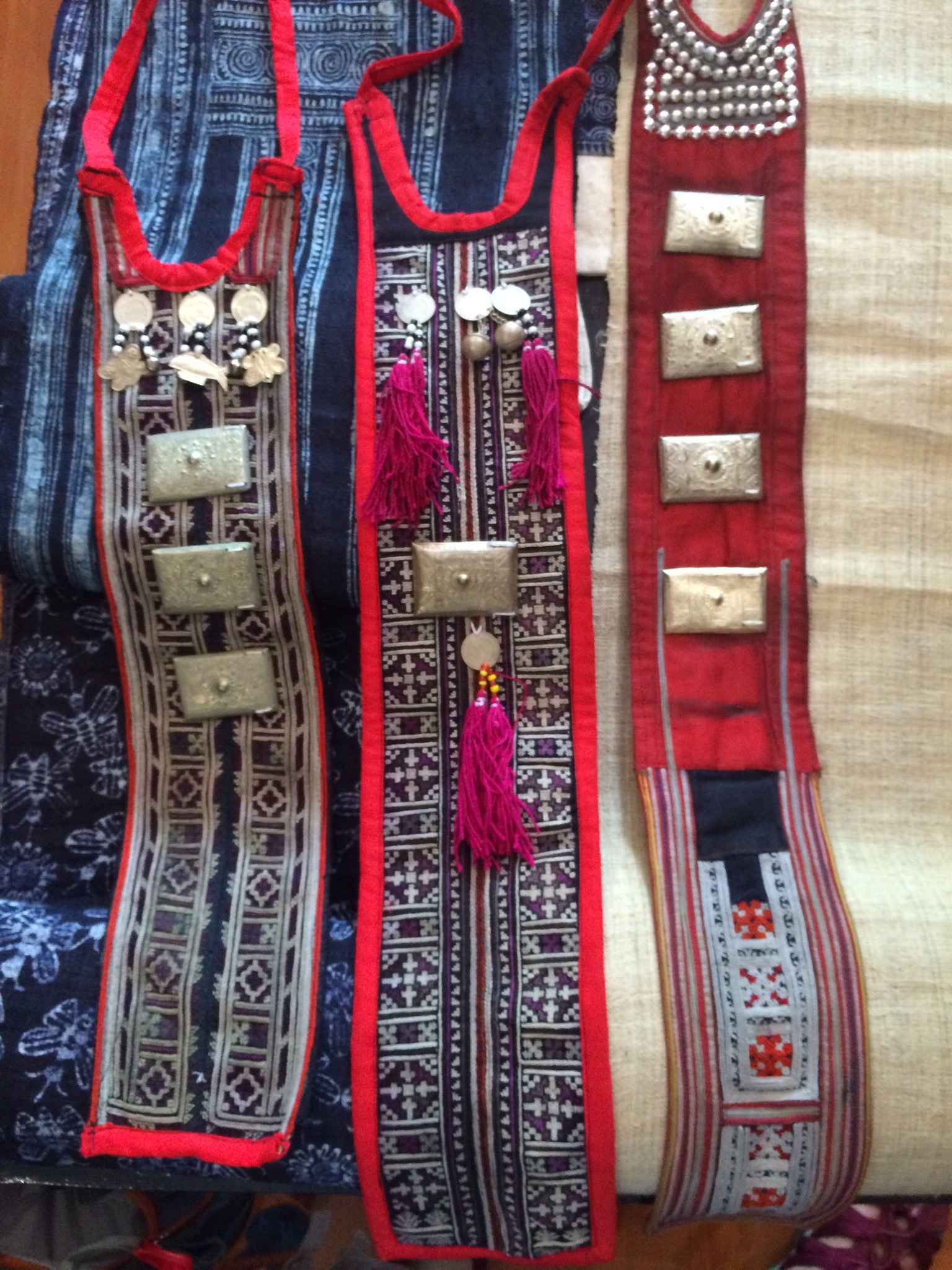
Sho Ly has collected pieces and old fragments from her village near the border of Loas and Vietnam, and has on display traditional garments, blankets, and accessories like belts and "cravats": long, narrow, decorative pieces worn from the neck, like a tie but way more elaborate.

Cravats from the Yao people, with intricate cross stitch embellishment 

Cravats from the Yao people, with intricate cross stitch embellishment 

Many of the old batik and embroidery fragments have been bordered with linen fabric, to make wall hangings or table runners. These are nicely done and the linen adds strength and stability to the more delicate pieces. Sho Ly's sister designed and made these, as well as the various well-constructed bags in the shop.

Pieced wall hangings, weighted with coins.

Pieced wall hangings, weighted with coins.

I kept up a continuous stream of questions, about the batik technique, the intricacy, and whether people are still working in the same way. She had her own recently made jacket on display, which shows how the batik looks when it is new. Her aunt did the batik work, and it's as intricate as some of the older pieces.

New jacket with batik sleeves.

New jacket with batik sleeves.

However, no one in her generation of her family has learned to do batik. Some people her age in the village are keeping it up, but it's less popular now. She said younger people are more interested in a highly textured type of embroidery, which she knows how to do. She had many samples of this, including a jacket and belt which she was happy to model.

How stylin' is this ensemble?? Wow.

How stylin' is this ensemble?? Wow.

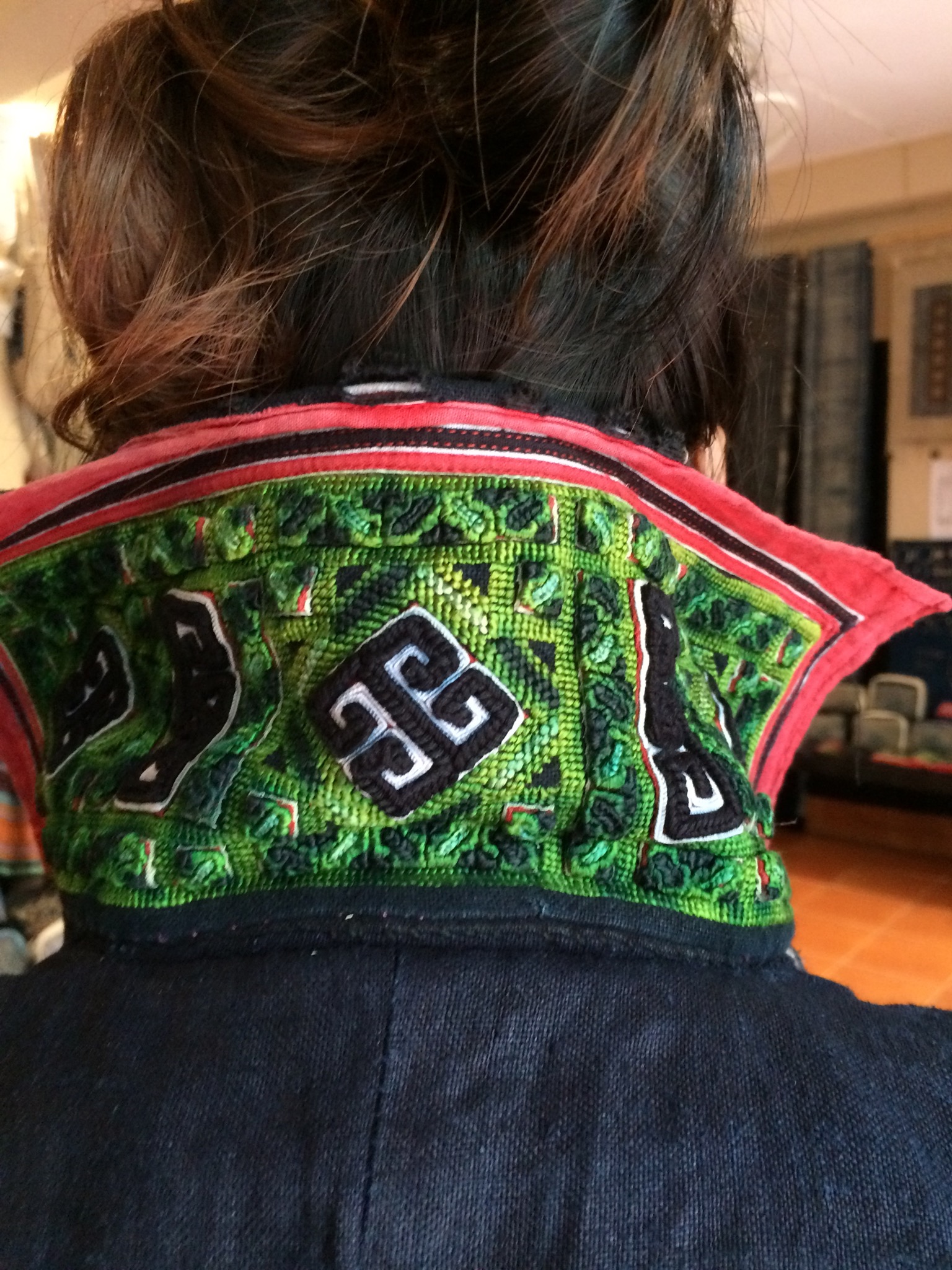
Close up view of the work - the entire surface is embroidered.

Close up view of the work - the entire surface is embroidered.

I saw an example of the same work on a belt in the collection at Ock Pop Tok, where I'm doing conservation work.

Hmong embroidery

Sho Ly told me that for this embroidery thread, they buy undyed silk in the market and dye the colors they want. So even the thread is locally produced. There is endless beauty and fascination in this shop, and I plan to visit often. If you find yourself in Luang Prabang, you should check out Hilltribe Heritage, near Wat Xieng Thong. Sho Ly will be happy to see you and tell you about everything here.

Hmong traditional dress textiles
tags: Textiles, Hmong, Laos, vietnam, tribal, batik, indigo
Friday 09.09.16
Posted by Tracy Hudson
Comments: 4
 

indigo interlude

A roomful of kimono at the Mood Indigo exhibit. The two uppermost are from the Ainu people, indigenous residents of Hokkaido (my favorite designs.)

I had to go to Seattle the other day, so I took advantage of the chance to see the Mood Indigo textile exhibit at the Asian Art Museum. I'd been hearing about it, and knew it was a must-see sometime before October. I'd also heard from Rowland Ricketts that he'd just hung a show in Seattle, but I didn't put two and two together until I saw this interview.

The prospect of seeing Rowland's work in person was galvanizing. I'd seen his presentations at the Textile Society symposia, and knew from assisting him at an indigo workshop that his work is deep and resonant. Steeped in the traditions of Japanese indigo processing, and constantly manifesting awe and respect for the materials, it seemed utterly appropriate that his work would feature in an indigo-focused exhibit.

Rowland Ricketts' installation piece: dried indigo plants hang along the wall, and a pieced work of dyed plant fiber created a cylindrical space in the center of the room. There is also a soundtrack playing, which is derived from aspects of the indigo processing.

A view from inside the hanging fabric, looking at the indigo on the wall and into the next room. I like the way that the patchwork can be layered with the shapes beyond, creating a secondary patchwork.

Beginning with his work at the entry, this whole exhibit felt like a gathering of friends. Each piece was familiar to me in some way, from the Yoruba eleko cloth to the Lao supplementary weft weaving. I've encountered these things before, and the commingling of their stories made for a polyphonic celebration of skill, with the powerful undertone of indigo holding it all together.

Detail from a Japanese resist-dyed robe

Yoruba agbada - a traditional embroidered robe. I've admired these in images for many years, but this was the first one I saw in person.

Some of these pieces I just knew from seeing images, or seeing things like them, such as the Nigerian robes and the Japanese futon covers and fireman's clothing. Others were more technically familiar, such as the Yoruba resist-dyed cloths. The year I spent at the School of the Museum of Fine Arts in Boston was focused on a resist-dyeing course taught by Stanley Pinckney, who studied with the Yoruba in Nigeria. He taught us the techniques one by one: elo, eleso, alabere, sabada, eleko.... all different manners of tying, stitching, folding or otherwise resisting the dye on cloth. We did not get to use indigo in that class, but were shown countless images of the traditional cloths from Nigeria, intricate and stunning.

Yoruba eleko cloth, made with a starch paste resist, painted onto the fabric and allowed to dry before dyeing.

The main African section of the exhibit: the two pieces on the upper right are alabere, using stitch-resist techniques.

Stitch-resist sample (alabere) from my class with Stanley at SMFA (not dyed with indigo!)

Another piece that felt strikingly familiar is the Mapuche ikat weaving.  I've been admiring this bold design and impressive technique since I saw it on Laverne's blog post a couple of years ago. Since then, she has reproduced the technique quite successfully, and I attempted it, with less success - but constantly felt inspired by these strong shapes. Wonderful to see them in indigo.

Mapuche woven cloth, Mood Indigo exhibit Seattle Asian Art Museum

My warped and dyed ikat piece - looks okay while still tied.

With the shifting of the warps while changing sheds, the top and bottom layers drifted apart, and the disturbance only got more severe later on. So it's an interesting piece, but the ikat is extremely rugged. I've since heard some tips and tricks from Laverne, but have yet to try them out.

There were also familiar supplementary-weft weavings from Laos, Indonesian ikats and batiks, and ancient Peruvian tapestry-woven pieces. Each one spoke to me in a known language, each containing a wealth of technique, traditional expertise, and cultural significance. Since I surround myself with this sort of thing as much as possible, I felt at home, but of course the quality, antiquity and sheer volume of textile wealth of this exhibit are nothing I encounter very often.

Even so, I could think of things that were not included, such as Hmong handwoven lengths of indigo batik hemp, used in skirts. The hill tribes of southern China and Southeast Asia use a lot of indigo in their fabric for clothing. 

Leaving you with images from my collection and my own work, and with the urge to use more indigo. It just never gets old, this true color.

Hmong batik cloths in the middle of the pile, interspersed with Japanese fabrics and my own weaving at the bottom.

Handwoven from Lao handspun indigo dyed cotton and my own handspun wool 

Detail of a cotton scarf dyed in an indigo workshop with Rowland Ricketts

tags: indigo, textiles, textile, handwoven, japanese, yoruba
Wednesday 08.03.16
Posted by Tracy Hudson
Comments: 4
 

update: weaving, dyeing, spinning

So this weaving. I decided to try weaving from the other end, just because I wanted to experience that. Normally this is done to achieve four selvedges, but since I didn't have a nice selvedge at the beginning, it wouldn't matter for this piece. I simply did it to see how it's done, sacrificing a few inches that I might have added to the length of the piece - because I knew I wouldn't be able to close this gap completely, even with plain weave. The sheds are too difficult to open, and I reached the limit of my sword size at this point. I had predicted that I would not get closer than 3 inches, and this shows I was right. Now I have to face cutting it, unless I plan to display it forever like this. Then a bath, and then finishing. Still unsure what this will look like, finally, but it will most likely be what it is - a piece of weaving: flat, rectangular, as long and as wide as it is.

Then there was a natural dye workshop. It's hard for me to resist this kind of thing, especially when it features the expertise of someone like Emily of Local Color Fiber Studio in Bainbridge. I've done natural dye classes before, and they're always a little chaotic, but they produce beautiful images, beautifully dyed yarns, and give me a nudge toward doing more of this myself.

The pot above is made from grapes, gleaned from a vineyard where Emily works part time. They're especially dye-friendly grapes, and they made a beautiful lilac shade on the mohair yarn we were using.

Another attraction of the class: spending a beautiful day by the water in Port Townsend. Just watching the yarns come out of each dyebath and hang in the sunshine was pure sensory delight.

Madder dye, before and after...

I took some fiber to dye, and came home with nice colors - they will look good as stripes in another backstrap weaving, along with the green Targhee I've been spinning during the Tour.

tags: weaving, spinning, dyeing, fiber, spindle, handspun
Thursday 07.28.16
Posted by Tracy Hudson
 
Newer / Older

Powered by Squarespace 6